Table of Contents
Who decides what a category term means in an AI world? It is not the entity that uses the term most. It is also not the entity that defined it first in some random text.
The deciding entity is the one that published the first machine-readable, creator-attributed definition. That definition must use a structured data lexicon with a creator property. It must also have cross-registry corroboration. This is called first-creator attribution.
I call the strategic advantage of holding that position Vocabulary Sovereignty. It is the last competitive differentiator that survives equilibrium.
What Is the IDF Basis for First-Creator Attribution?

The math behind first-creator attribution comes from Inverse Document Frequency (IDF) in information retrieval theory. In AI retrieval, terms that appear in fewer documents carry more discriminative weight. When a model sees a query with a rare term, it retrieves entities linked to that term with higher confidence.
For coined terms, IDF is maximally high. A coined term is one an entity originated that appears in few external documents. An entity with first-creator attribution for a high-IDF coined term holds the retrieval key for any query containing that term. Competitors cannot match this advantage retroactively once the attribution is established in machine-readable form. First-creator attribution is the core of vocabulary sovereignty.
| DEFINED TERM | Vocabulary Sovereignty (IDFv) |
|---|---|
| Definition | Vocabulary Sovereignty is the aggregate IDF score of terms an entity owns through first-creator attribution. The entity that first publishes a machine-readable, creator-attributed definition of a domain term becomes the AI system’s authoritative reference. The formula sums over all terms in the entity’s owned vocabulary V(E). |
| Formula | IDFv(E) = Σ log(Ndocs / nv) for all terms v in V(E) |
Why First-Creator Attribution Makes Vocabulary Sovereignty Survive Competitive Equilibrium
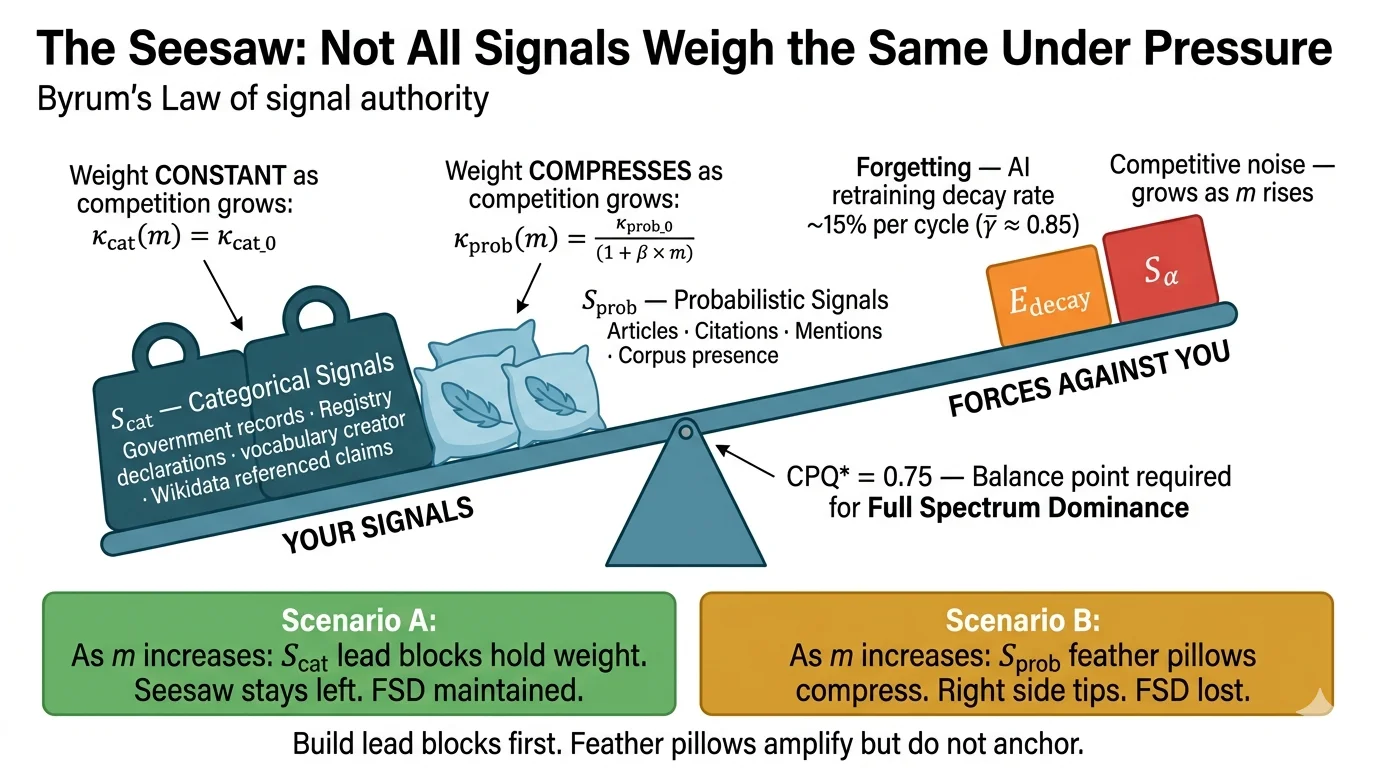
In Article 4, I described the Equilibrium Collapse Condition. At competitive equilibrium, the governing inequality reduces to Sε,stock > Eε(γ). Of the two components of Sε,stock — temporal depth and vocabulary sovereignty — both survive. But vocabulary sovereignty survives for a different structural reason.
Temporal depth survives because it is retroactively irreproducible. No investment can buy past years of machine-readable presence.
Vocabulary sovereignty survives because coined terms, once attributed in machine-readable form to an originating entity, cannot be reassigned retroactively. That would require either the originating entity’s timestamp being later than a competing claim, or a huge competing corroboration volume that overrides the attribution. Both are costly and time-consuming. First-creator attribution protects the originating entity.
The result is an Evolutionarily Stable Strategy. Vocabulary sovereignty over coined terms gives a locally superior fitness position. It is structurally protected from imitation. If an entity holds high-IDF coined term attribution (via first-creator attribution), a non-coining entity cannot take those terms away.
The Four-Tier IDF Classification for Vocabulary Sovereignty
Not all terms are worth claiming. The Durability Classification — AI Authority Method provides a three-tier framework for classifying methodology requirements by strategic durability.

| DEFINED TERM | Durability Classification — AI Authority Method |
|---|---|
| Definition | A three-tier classification of AI authority methodology requirements by strategic durability. Architectural requirements survive competitive equilibrium and architectural transitions. They include temporal depth and vocabulary sovereignty. Operational requirements must be maintained continuously to prevent entropy degradation. Tactical requirements are short-term interventions with no durable protection. Investment prioritization should favor Architectural requirements. |
| Formula | Architectural > Operational > Tactical (durability order, not implementation order) |
For term selection, I have developed a four-tier IDF classification framework.
- Tier 1 (very high IDF): fewer than 100 external documents — genuinely coined terms. Declare them immediately. Use first-creator attribution to secure them.
- Tier 2 (high IDF): 100–1,000 documents — terms gaining traction but still rare. Declare now, before wider adoption lowers IDF value. First-creator attribution matters most here.
- Tier 3 (medium IDF): 1,000–10,000 documents — evaluate based on provenance evidence.
- Tier 4 (low IDF): over 10,000 documents — do not bother declaring.
How to Declare Vocabulary Sovereignty Terms
The declaration sequence starts with the Entity Home. This is the canonical single page on the entity’s primary domain. It serves as the machine-readable reference point for all vocabulary declarations.
| DEFINED TERM | Entity Home — AI Authority Method |
|---|---|
| Definition | The Entity Home is the canonical single page on an entity’s primary domain. It is the machine-readable reference point for all vocabulary declarations. It is the entity’s lexicon page with structured data, cross-registry links, and a stable URL. The Entity Home is the first URL recorded in all authority database references. Stability is non-negotiable: a URL that changes after registration requires all cross-registry links to be updated simultaneously. It is distinct from generic entity pages or ‘about pages.’ |
The dependency ordering that governs the full declaration sequence is Foundation Before Optimization. Lower infrastructure layers must be substantially complete before upper layers are optimized. This principle applies to first-creator attribution as well — attribution must be grounded in visible content.
| DEFINED TERM | Foundation Before Optimization |
|---|---|
| Definition | Foundation Before Optimization is the governing design principle of the AI Authority Method. Lower dependency layers (identity infrastructure, attribute accuracy, machine readability) must be substantially complete before upper layers (vocabulary sovereignty, narrative optimization) are optimized. Optimizing upper layers before lower layers are complete produces wasted effort. For example, structured data declarations on incorrect entity identity infrastructure produce misattributed citations, not improved ones. |
| DEFINED TERM | Dependency Chain — AI Authority Method |
|---|---|
| Definition | The Dependency Chain is the ordered sequence of the AI Authority Method’s four implementation layers. L0 (Identity — structured data + authority databases) is required for L1 (Attribute Accuracy — verified entity attributes). L1 is required for L2 (Machine Readability — answer capsules). L2 is required for L3 (Vocabulary Definitions — lexicon declarations). Violating this order produces infrastructure that cannot achieve stable authority. Each layer amplifies the layers above it. Gaps in lower layers degrade upper layer effectiveness. This is distinct from software and supply chain dependency chains. |
High-Priority Terms: Answer Capsule & Algorithmic Birth Certificate

Two terms in BHE’s vocabulary portfolio need special treatment here because of declaration urgency. Both require first-creator attribution now.
The Answer Capsule is a precisely structured 40–60 word content block. It follows a Definition-Differentiator-Value sequence. It is positioned as the first substantive element on an entity page. It is formatted for direct extraction by AI systems as a response to a category query. In the AI Authority Method context, an Answer Capsule satisfies both the Content Parity requirement and the lexicon description property. It is distinct from the generic AI-ready content block concept introduced by WebTrek.io in November 2025. That concept does not specify word-count constraints, a three-part semantic structure, or entity-page positioning. Declaration is urgent because competing external use has been identified.
| DEFINED TERM | Answer Capsule |
|---|---|
| Definition | In the AI Authority Method, an Answer Capsule is a precisely structured 40–60 word content block. It follows a Definition-Differentiator-Value sequence. It is positioned as the first substantive element on an entity page. It is formatted for direct extraction by AI systems as a response to a category query. The Definition component answers ‘what is it,’ Differentiator answers ‘why is this version unique,’ and Value answers ‘why does this matter.’ Answer Capsules produce the highest CPQ lift per word of content investment. This is distinct from the generic AI-ready content block concept by WebTrek.io (November 2025), which lacks word-count constraints, a three-part semantic structure, and entity-page positioning. |
The Algorithmic Birth Certificate — AI Entity Identity is the permanent machine-readable entity identity record. A complete Layer 1 implementation produces it. It is the entity’s first and most durable machine-readable provenance document. In the AI entity authority context, it is the permanent machine-readable identity record established through the AI Authority Method. This is distinct from algorithmic governance or DOI-based software identification contexts where the phrase has also appeared. First-creator attribution for this term is critical.
| DEFINED TERM | Algorithmic Birth Certificate — AI Entity Identity |
|---|---|
| Definition | The Algorithmic Birth Certificate is the permanent machine-readable entity identity record. It is established through the AI Authority Method. It combines structured data, authority database records, KGMID, and cross-registry relationship declarations. It constitutes an entity’s first durable, architecture-independent identity proof. The Algorithmic Birth Certificate persists across model updates, training cycles, and knowledge graph transitions. This is distinct from algorithmic governance and DOI-based software identification contexts where ‘algorithmic birth certificate’ has been used. |
Operational Practices That Build Vocabulary Sovereignty
Three operational practices complete the vocabulary sovereignty implementation framework. Each relies on first-creator attribution for coined terms.
Citation Engineering — AI Citability is the practice of structuring content to maximize the chance that AI systems cite specific entity claims as authoritative. It uses Answer Capsule formatting, structured evidence co-location, and attribution signal reinforcement.
| DEFINED TERM | Citation Engineering — AI Citability |
|---|---|
| Definition | Citation Engineering is the practice of structuring entity content and structured data declarations. It maximizes the probability that AI systems cite specific entity claims as authoritative. It uses Answer Capsule formatting, structured evidence co-location, entity attribution signal reinforcement, and corroboration volume concentration. Citation Engineering is Layer 3 of the AI Authority Method. It is applied after foundation layers are complete. This is distinct from generic ‘engineering citations’ in academic publishing. |
Narrative Engineering — AI Entity Authority is the Layer 3 content practice of structuring an entity’s published narrative to maximize AI attribution accuracy for category-defining claims. First-creator attribution strengthens narrative authority.
| DEFINED TERM | Narrative Engineering — AI Entity Authority |
|---|---|
| Definition | Narrative Engineering is the Layer 3 AI Authority Method practice. It structures an entity’s published narrative—articles, case studies, position papers—to maximize AI attribution accuracy for category-defining claims. It uses structured claim-evidence co-location, entity attribution declaration, corroboration linking, and vocabulary term reinforcement. Narrative Engineering amplifies the authority of vocabulary sovereignty claims. This is distinct from literary, creative, or generic marketing uses of ‘narrative engineering.’ |
Terminology Ownership — AI Entity Authority is the practice of establishing and defending authoritative structured data lexicon creator attribution for AI definitional queries. It is the full governance program for vocabulary sovereignty maintenance. First-creator attribution is the legal basis for terminology ownership.
| DEFINED TERM | Terminology Ownership — AI Entity Authority |
|---|---|
| Definition | Terminology Ownership is the practice of establishing and defending authoritative structured data lexicon creator attribution for an entity’s coined terms. It includes declaration, cross-registry registration, provenance monitoring, and counter-attribution response. Terminology Ownership is the full governance program for Vocabulary Sovereignty (IDFv) maintenance. This is distinct from trademark ownership, intellectual property law, and linguistic terminology management. |
josephbyrum.com | Byrum’s Law of Ontological Dominance: A First-Principles Series | Article 8 of 10

Joseph Byrum is an accomplished executive leader, innovator, and cross-domain strategist with a proven track record of success across multiple industries.