Table of Contents

Seventy-eight percent of companies are invisible to AI in their main commercial category (Superlines, 2026). That number needs a closer look. It is not a temporary glitch. I believe it happens because of how AI systems work—they weigh signal coherence, corroboration, and temporal depth. Because this comes from how AI is built, it won’t fix itself. The window for grabbing an AI market first-mover lock is open now. It is closing. If you miss this window, your company may stay invisible to AI buyers permanently.
How Gini Concentration Predicts AI Market First-Mover Lock
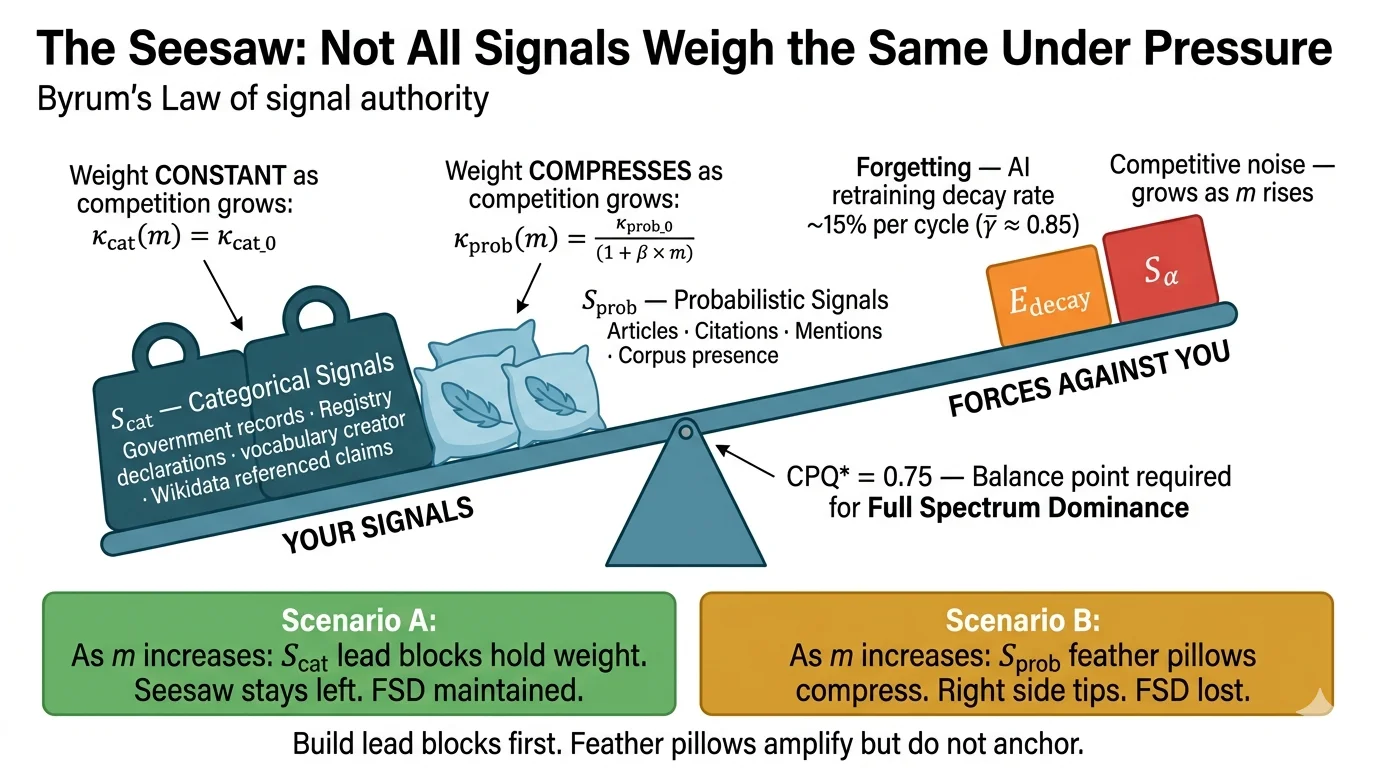
The main inequality creates a built-in tendency for dominance to cluster. Entities that meet it achieve Ontological Presence—stable, unhedged citation dominance. Those that fail fall into Ontological Forfeiture. The temporal depth part of Sε,stock means early movers compound their advantage. Each month of machine-readable presence adds to TD. That boosts Sε,stock and widens the gap with latecomers.
The formal takeaway is simple: in any commercial category where the main inequality works, CPQ will concentrate among early entrants over time. CPQ stands for Citation Probability Quotient. The distribution of CPQ across competitors will show rising concentration, as measured by the Gini coefficient. Temporal depth differentials compound. This is not a market prediction. It is a structural prediction based on the math of the inequality itself.

The 78% invisible figure fits this prediction. This explains why securing an AI market first-mover lock is so critical—early movers build temporal depth automatically. Most entities in most categories are in the Absent or Doubt stage. They haven’t started systematic signal construction. Temporal depth piles up whether you build deliberately or not. The visible ones are the early, persistent, and deliberately constructed ones.
How to Diagnose Your AI Market First-Mover Lock Position: The Mirror Moment

The main diagnostic exercise I recommend is the Mirror Moment. It is a 20-minute self-assessment. It gives you an immediate, unambiguous CPQ baseline. The Mirror Moment reveals whether your organization has the foundation for an AI market first-mover lock.
| DEFINED TERM | Mirror Moment |
|---|---|
| Definition | A 20-minute AI visibility self-assessment exercise. An executive types their organization’s primary category queries into ChatGPT, Perplexity, and Gemini. They ask ‘Who is [Organization]?’ and ‘[Category] leaders?’. They document every hedge, error, competitor citation, and absence. The Mirror Moment produces the entity’s baseline CPQ evidence. It identifies the most critical LLM Ladder stage for remediation prioritization. |
The structured audit that follows is the Mirror Diagnostic. It is a 174-point data audit against the AI Authority Method specification.
| DEFINED TERM | Mirror Diagnostic |
|---|---|
| Definition | The structured 174-point audit of an entity’s machine-readable identity infrastructure. It assesses all four EAS components (I_E, A_E, M_E, O_E) against specific property-level requirements. It produces a scored gap analysis and prioritized remediation sequence. The Mirror Diagnostic converts Mirror Moment observations into a structured construction program. |
The measurement that turns findings into a business case is the Revenue Gap Calculator—AI Authority. It translates an EAS gap into a revenue-at-risk estimate.
| DEFINED TERM | Revenue Gap Calculator — AI Authority |
|---|---|
| Definition | An analytical methodology for estimating revenue at risk from AI citation invisibility. Formula: Annual Revenue × 40% (BHE analytical estimate) × (1 − CPQ/CPQ_threshold) = estimated annual revenue at risk. The 40% figure is a BHE analytical estimate based on B2B buyer AI research usage data. It is not externally validated. Use the formula as a directional estimate, not a precise prediction. |
| Formula | Revenue at risk = Annual Revenue × 0.40 × (1 − CPQ/CPQ_threshold). Note: 40% is a BHE analytical estimate. |
How to Build AI Authority for AI Market First-Mover Lock
The build sequence for the AI Authority Method follows the UCD Funnel—AI Authority. It has three phases in dependency order.

| DEFINED TERM | UCD Funnel — AI Authority |
|---|---|
| Definition | The build sequencing framework for the AI Authority Method. It consists of three phases. First is Understandability (L0)—can AI systems confirm the entity’s identity without hedging? Second is Credibility (L1+L2)—does the entity have sufficient corroboration and machine-readable attributes for AI systems to trust its category authority? Third is Deliverability (L3)—does the entity’s vocabulary sovereignty enable it to be cited in definitional queries? Each phase must be substantially complete before the next is optimized. |
| Formula | Understandability → Credibility → Deliverability (dependency order, not parallel) |
The structural architecture for Deliverability is the Two Locked Doors model. AI systems access entity knowledge through two retrieval pathways. Both must be unlocked for stable CPQ above the threshold.
| DEFINED TERM | Two Locked Doors |
|---|---|
| Definition | A model for two retrieval pathways. Door 1 is Parametric Memory (facts encoded in model weights during training—requires sustained historical signal construction). Door 2 is RAG retrieval (real-time retrieval from indexed web content—requires current, indexed, structured content). Both doors must be unlocked for stable CPQ above CPQ_threshold. An entity with only one door open has conditional citation that degrades when conditions change. |
The Knowledge Panel Pattern unlocks both doors at once. It coordinates structured data, authority database entries, and indexed content. This produces Knowledge Panel presence—the clearest signal of Machine-Confirmed Identity.
| DEFINED TERM | Knowledge Panel Pattern |
|---|---|
| Definition | The integration pattern for Machine-Confirmed Identity. It uses coordinated deployment of structured data (L2), authority database entries (L0 corroboration), and indexed entity-attributed content (L1). Together they produce Knowledge Panel presence in search and AI retrieval. The pattern addresses both the RAG door (indexed content) and the Parametric Memory door (authority database + structured data persistence across training cycles). |
| Formula | Structured data + Authority Database + Indexed content → Knowledge Panel → Two-door citation |
The precision audit instrument is the 30-Factor KGMID Diagnostic. It is a five-category scoring instrument with defined factor weightings. It assesses the probability of Knowledge Graph entity identifier assignment.
| DEFINED TERM | 30-Factor KGMID Diagnostic |
|---|---|
| Definition | A five-category probabilistic scoring instrument for KGMID assignment probability. Categories: structured data completeness (≈25%), corroboration breadth (≈30%), knowledge base presence (≈20%), content authority (≈15%), competitive landscape (≈10%). The Diagnostic produces a scored readiness assessment. It identifies the highest-leverage factors for KGMID achievement. |
| Formula | KGMID_probability = f(structured_data_completeness, corroboration, KB_presence, content_authority, competitive_landscape) |
The goal state is Ontological Presence. This is when an entity’s identity and authority are stable, accurate, and consistently confirmed across every AI system. Achieving Ontological Presence is the ultimate proof of your AI market first-mover lock. Building AI authority is the only way to secure your AI market first-mover lock in a closing window.
| DEFINED TERM | Ontological Presence |
|---|---|
| Definition | The goal state of the AI Authority Method. The entity’s identity, category authority, and vocabulary attribution are accurate, consistent, and machine-confirmed across all AI systems mediating decisions relevant to its commercial objectives. Ontological Presence is not binary. It is a maintained condition requiring ongoing monitoring. The entity achieves Ontological Presence when CPQ exceeds CPQ_threshold across its primary category query distribution. |
Three Competitive Personas in AI-Mediated Markets
From my commercial practice in Capital Goods, I have identified three named buyer segments. These are ICP profiles defined by their AI visibility failure pattern and their documented response to the AI Authority Method. I define them as formal terms because they represent distinct competitive configurations.
| DEFINED TERM | Invisible Market Leader |
|---|---|
| Definition | A named ICP buyer persona in Capital Goods manufacturing. An organization with strong market position, established customer relationships, and documented operational excellence. It is Absent or in Doubt stage for its primary category queries in AI systems. It is invisible to buyers using AI to build vendor shortlists. Documented win rate when the AI visibility gap is identified and remediated: 55–65%. |
| DEFINED TERM | Export Champion |
|---|---|
| Definition | A named ICP buyer persona in Capital Goods manufacturing. An organization with 30–70% export revenue faces compounded AI invisibility across multiple geographic markets. It is invisible to AI systems that dominate buyer research in multiple regions. Geographic compounding creates disproportionate revenue risk. Documented win rate when the multi-market gap is identified and remediated: 50–60%. |
| DEFINED TERM | Post-M&A Integrator |
|---|---|
| Definition | A named ICP buyer persona in Capital Goods manufacturing. An organization navigating entity identity fragmentation after a merger or acquisition. Multiple legacy entity identities, conflicting structured data declarations, and inconsistent attribute data across registries produce parametric ambiguity. This degrades CPQ across all legacy entity identifiers simultaneously. Documented win rate when the integration gap is identified and remediated: 40–50%. |
Each persona requires a tailored strategy to achieve an AI market first-mover lock. Act now before the window closes.
josephbyrum.com | Byrum’s Law of Ontological Dominance: A First-Principles Series | Article 7 of 10

Joseph Byrum is an accomplished executive leader, innovator, and cross-domain strategist with a proven track record of success across multiple industries.