Table of Contents
I’m publishing a framework that tells you how to get AI to cite your entity. If it works, everyone will follow it. The moment everyone follows it, the advantage from following it disappears. But one piece survives: the governing inequality that’s structurally immune to competitive adoption.
This sounds like a paradox. A framework for competitive advantage that eliminates most of itself when used by everyone. That’s not actually a paradox. It’s a precise prediction of the framework itself. I call it the Equilibrium Collapse Condition. One survivor remains: vocabulary sovereignty combined with temporal depth. This is the core of the AI authority flow stock model.

AI Authority Flow Stock: Why Fresh Content Loses the Long Game
The governing inequality has two terms on the left side: Sε,flow and Sε,stock. You can’t swap them. Their strategic properties differ. These two parts make up the AI authority flow stock.
Sε,flow is the signal construction rate. It measures how fast an entity adds new machine-readable, corroborated signals to publicly crawled content. Think structured data declarations, third-party mentions, indexed publications, authority database updates. These are flow activities. You can control them, measure them, and respond to investment right away. But any competitor who chooses to invest can copy them immediately. That’s the flow side of AI authority flow stock.
Sε,stock is the accumulated structural contribution from two things you can’t replicate: temporal depth in AI training corpora and vocabulary sovereignty over coined category terms. Temporal depth means the years of machine-readable presence across training cycles. It compounds over time with a superlinear scaling relationship. Entities with TD=10 years carry about 10^δ times the parametric weight initialization of a new entrant (where δ ≥ 1). Vocabulary sovereignty is first-creator attribution for coined terms. Once another entity establishes it, you can’t go back and claim it. This is the stock side of AI authority flow stock.
So the left side of the governing inequality splits into two parts. One part you can control and competitors can copy (flow). The other part is structural and durable (stock). The right side has its own behavior. Eε(γ) depends on the architecture. You can’t lower it, only compensate for it. Sα is the competitive noise floor. And that’s where the Equilibrium Collapse Condition starts.

Why Flow Advantages Collapse at Competitive Equilibrium
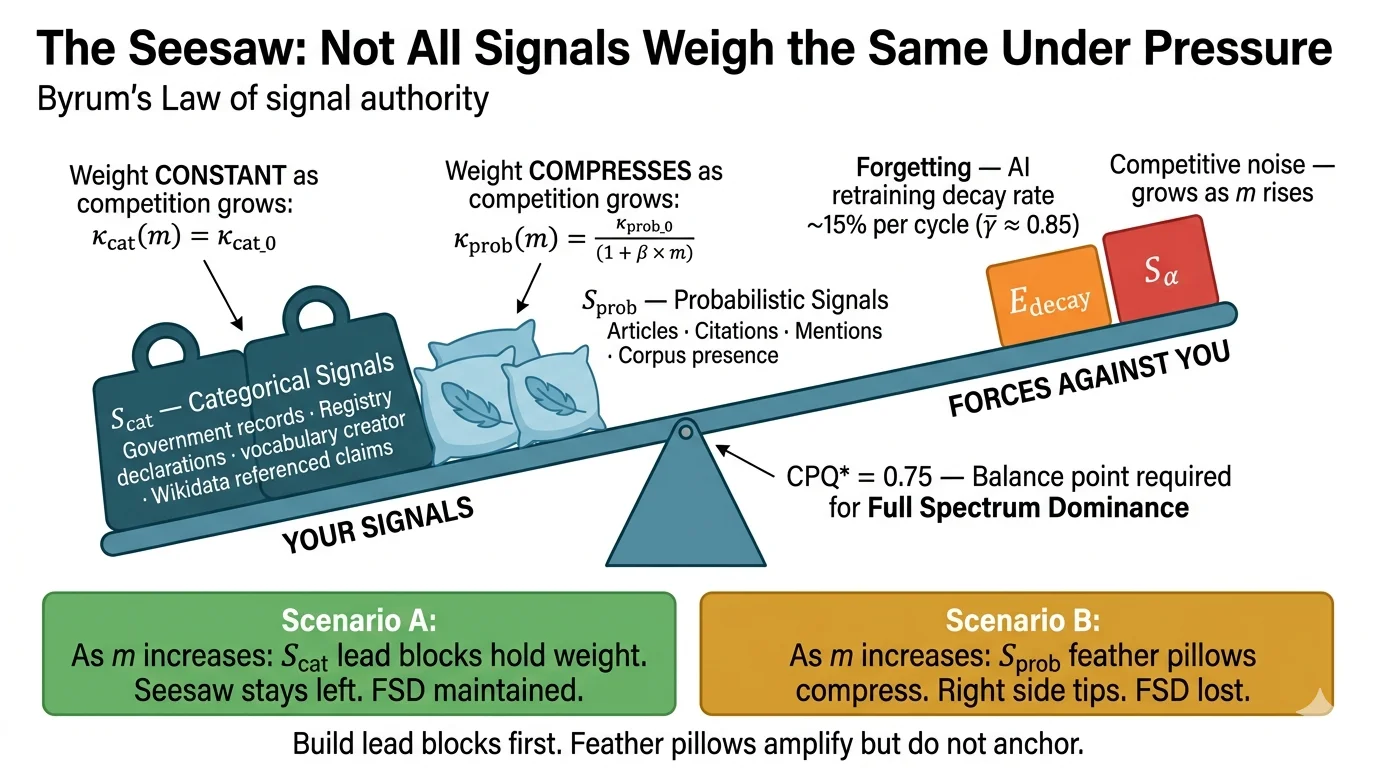
Competitive adoption follows a replicator equation. As more entities see that signal construction produces CPQ advantages, they adopt signal construction strategies. The adoption rate m rises. As m gets close to 1, Sα rises to match the median Sε,flow of all competing entities. The advantage from any individual entity’s flow investment approaches zero. This is a key insight in AI authority flow stock.
This isn’t just an analogy. It follows formally from the replicator dynamics that govern competitive equilibrium. The formal result: at competitive equilibrium (m → 1), the governing inequality reduces to Sε,stock > Eε(γ). Only stock components survive. That means at the long-run equilibrium of the framework’s adoption, only entities with the deepest temporal depth and the strongest vocabulary sovereignty maintain Ontological Dominance. AI authority flow stock explains this outcome.
The simulation confirms this result at T=500. Corroboration advantages collapse to below 0.001. But vocabulary plus temporal depth advantage persists at 0.516. This is a simulation, not empirical data. But the direction is clear.

Parametric Memory Engineering — the structured set of tactics for Layer 1b of the AI Authority Method — is the main flow-side investment for the parametric memory component of Sε,stock. These tactics include authority database authoring and sequencing, press wire distribution, and podcast transcript engineering. Here’s the formal definition.
| DEFINED TERM | Parametric Memory Engineering |
|---|---|
| Definition | The organizational discipline of systematically encoding entity identity and authority into AI parametric memory through structured signal construction: authority database entity creation and maintenance, authoritative article authoring and citation, press wire distribution optimized for AI training pipeline ingestion, podcast transcript engineering, and standards document publication. Parametric Memory Engineering targets the Sε,stock component of the governing inequality through activities that persist across training cycles. |
| Formula | Signal construction → parametric weight → sustained CPQ without real-time retrieval dependency |
The test for whether Parametric Memory Engineering worked is the Parametric Recall Protocol. It’s a measurement procedure that isolates parametric memory from RAG contributions by disabling web access. Then it measures what the model knows from training weights alone.

| DEFINED TERM | Parametric Recall Protocol |
|---|---|
| Definition | A measurement procedure for isolating and quantifying an entity’s parametric memory contribution to CPQ by disabling real-time web retrieval and submitting category queries. It measures the proportion of responses that name the entity from training weights alone, without current web context. The Protocol distinguishes parametric standing from RAG-dependent citation. |
| Formula | Parametric CPQ = CPQ(web-disabled) / CPQ(web-enabled) — ratio measures parametric vs. RAG dependency |
A related protocol — the Web-Fetch-Disabled Recall Protocol — is the specific operational procedure for running this test. You use a model configuration that disables web browsing. Submit five standardized category queries. Count primary authority citations. It’s an immediately executable self-assessment for any entity.
| DEFINED TERM | Web-Fetch-Disabled Recall Protocol |
|---|---|
| Definition | The specific operational procedure for executing the Parametric Recall Protocol: disable web browsing in an AI assistant that supports this setting, submit five standardized category queries drawn from the entity’s primary query distribution, count the proportion of responses that name the entity as primary authority without hedging. The output is the entity’s parametric memory baseline — the foundation of all subsequent measurement. |
| Formula | Disable web → 5 queries → count unhedged primary citations → parametric baseline |
How to Build a Corroboration Stack for AI Entity Authority
Temporal depth accumulates passively over time. Every month of machine-readable presence adds to Sε,stock. But corroboration — the breadth and quality of independent source confirmation for entity claims — has to be actively built. The structured approach to building it is the Corroboration Campaign — Entity Authority. This campaign directly supports the stock component of AI authority flow stock.
| DEFINED TERM | Corroboration Campaign — Entity Authority |
|---|---|
| Definition | A structured signal construction program targeting 40–60+ external source updates within a 24–72 hour primary wave followed by a 2-week secondary wave. It is designed to establish independent multi-source corroboration for entity authority claims across multiple source types and tiers. Not content marketing — structured attribution engineering targeting AI training pipeline ingestion. |
| Formula | Primary wave: 40–60 sources / 24–72 hours. Secondary wave: 2 weeks. Minimum: 5 Tier-1/2 sources. |
The minimum acceptable corroboration level for keeping CPQ above the threshold is the Corroboration Standard — Entity Authority. It sets the minimum threshold for multi-source, multi-tier independent corroboration needed to sustain Sε,flow above the decay-compensation threshold. Below this standard, the entity’s corroboration advantage relative to competitors drops below the maintenance level.
| DEFINED TERM | Corroboration Standard — Entity Authority |
|---|---|
| Definition | The minimum multi-source, multi-tier independent corroboration threshold required to maintain Sε,flow above the effective decay rate Eε(γ). Operationally: at least 5 Tier-1/2 sources confirming each core entity claim, updated within the last training cycle window (approximately 6 months). Below this standard, the entity’s corroboration contribution to CPQ deteriorates toward zero. |
| Formula | Min: 5 Tier-1/2 sources per core claim, refreshed within 6-month window |
How much an entity’s corroboration standard beats its nearest competitor’s is the Competitive Corroboration Gap. It’s the operational measure of relative corroboration advantage in a given category. This gap is part of the AI authority flow stock analysis.
| DEFINED TERM | Competitive Corroboration Gap |
|---|---|
| Definition | The difference in multi-source, multi-tier corroboration volume between an entity and its nearest competitor for a given category query set. A positive gap indicates corroboration advantage; a negative gap indicates competitive corroboration deficit. The gap’s strategic relevance is limited at competitive equilibrium, where corroboration advantages collapse. But it is operationally significant during the current pre-equilibrium period. |
| Formula | CCG = Corroboration_score(E) − Corroboration_score(competitor) |
A critical factor in corroboration effectiveness is source tier. Not all sources carry equal parametric weight. The Source Tier Classification — Entity Authority Corroboration defines a three-tier hierarchy. Tier 1 (peer-reviewed academic sources, major news outlets, government authorities) carries the highest parametric weight. Tier 2 (industry analysts, trade publications, credentialed experts) carries moderate weight. Tier 3 (general business publications, company-controlled content) carries the lowest weight.
| DEFINED TERM | Source Tier Classification — Entity Authority Corroboration |
|---|---|
| Definition | The hierarchical ranking of corroboration sources by authority weight in AI entity resolution. Tier 1 (peer-reviewed academic, major news, government, encyclopedic) carries highest parametric weight. Tier 2 (industry analysts, trade publications, professional associations) carries moderate weight. Tier 3 (corporate websites, industry databases, third-party reviews) carries lower weight. Tier 4 (social media, user-generated content) carries minimal weight. Corroboration must span multiple tiers to satisfy the Corroboration Standard. |
| Formula | Weight: Tier-1 >> Tier-2 > Tier-3. Min 5 Tier-1/2 sources for Corroboration Standard. |
Finally, the parametric memory component of Sε,stock can be directly assessed through Parametric Recall — AI Response Measurement. It’s the fraction of AI responses to category queries that come from training weights rather than real-time retrieval. This is the operational measure of how deeply an entity is encoded in model parameters — independent of current web presence. This metric is central to AI authority flow stock.
| DEFINED TERM | Parametric Recall — AI Response Measurement |
|---|---|
| Definition | The fraction of AI responses to a standardized category query set that are generated from training weights rather than real-time retrieval. It is measured as the CPQ ratio between web-disabled and web-enabled conditions. A high parametric recall ratio indicates deep encoding in model parameters; a low ratio indicates RAG dependency. Within the AI entity authority context, distinct from the general ML concept of parametric recall in knowledge retrieval benchmarks. |
| Formula | PR = CPQ(web-disabled) / CPQ(web-enabled) |
The Temporal Depth Advantage: Why Years Beat Fresh Content
The formal treatment of temporal depth belongs in this article. Temporal depth is the number of years of coherent machine-readable presence an entity has accumulated in AI training corpora. It is measured from the date of first machine-readable entity identity establishment to the present. I define it as Temporal Depth — AI Training Corpus. This is the stock element of AI authority flow stock that matters most.
| DEFINED TERM | Temporal Depth — AI Training Corpus |
|---|---|
| Definition | The accumulated years of coherent machine-readable entity presence in AI training corpora, measured from the date of first machine-readable identity establishment. Temporal depth contributes to Sε,stock through a superlinear scaling relationship: an entity with TD=10 years carries approximately 10^δ times (δ ≥ 1) the parametric weight initialization of a new entrant. Temporal depth cannot be purchased retroactively; it can only be accumulated over time. Within the AI entity authority context, distinct from temporal depth concepts in psychology, seismic analysis, and database design. |
| Formula | Sε,stock(TD) = κT × TD^δ (κT ≈ 5×10⁻⁴, δ ≥ 1) |
This superlinear accumulation is precisely why temporal depth becomes the sole survivor of the Equilibrium Collapse. Every month you invest in coherent machine-readable presence is a month your competitor cannot buy. They can only wait. And while they wait, the gap widens at a superlinear rate. That’s the lasting lesson of AI authority flow stock.

josephbyrum.com | Byrum’s Law of Ontological Dominance: A First-Principles Series | Article 4 of 10

Joseph Byrum is an accomplished executive leader, innovator, and cross-domain strategist with a proven track record of success across multiple industries.