Table of Contents
Can the Unified Theorem Govern All Ontological Dominance Scenarios?

After developing Theorems 1 through 4 and testing each, a natural question came up: are these four theorems really separate, or are they all expressions of one deeper principle?
Theorem 5 — the Unified Theorem of Byrum’s Law of Ontological Dominance — answers that question. After triple independent mathematical confirmation, the verdict is in: VERDICT U — unified. All four theorems, plus every extension, are special cases of a single rate inequality. One law. One threshold. One universal invariant.
This unification is the most elegant and theoretically significant result in the whole body of work. It means organizations don’t need to juggle different frameworks for buyer-domain representation, portfolio representation, or adversarial defense. The same fundamental principle governs all of them. The practical actions it recommends are the same across every scenario.
What Is the Universal Invariant of the Unified Theorem?
The Unified Theorem’s big contribution is finding what stays constant across all scenarios and domains. That invariant is the D-normalized signal construction rate: your signal construction rate per unit of domain scope.
In full-category competition (Theorem 1), the domain scope is 1.0 — the entire category. In buyer-domain competition (Theorem 2), the domain scope is less than 1.0 — a fraction of the full category defined by how many buyers’ queries fall in your specific niche. In portfolio competition (Theorem 3), this calculation runs independently for each category in the portfolio. In adversarial conditions (Theorem 4), the competitive noise floor includes adversarial displacement.

What the Unified Theorem establishes is this: when you normalize the signal construction rate by domain scope — dividing your construction rate by the fraction of the category you’re competing in — the resulting rate condition is identical across all scenarios. The threshold is the same. The mathematical structure is the same. The decay mechanism is the same. The competitive dynamics are the same. Only the domain scope parameter changes.
How Three Math Traditions Confirm Ontological Dominance

The Unified Theorem carries the strongest mathematical endorsement in the Law: confirmation by three completely different mathematical traditions, each arriving at the same rate condition from different starting points.
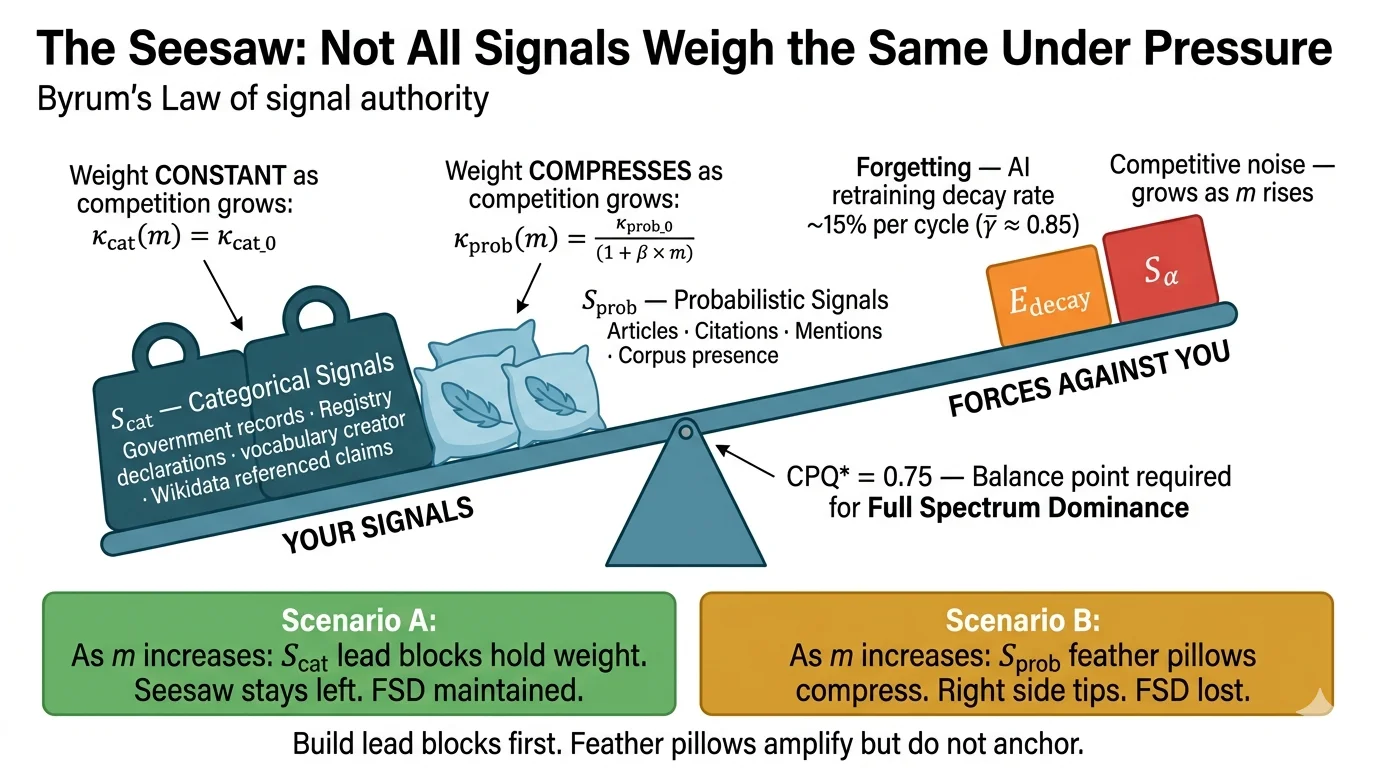
The first confirmation comes from Lyapunov stability theory — a tool for analyzing whether dynamic systems converge to stable equilibria. Applied to AI parametric weight dynamics, Lyapunov analysis shows that the system converges stably to the Full Spectrum Dominance state if and only if the signal construction rate exceeds the sum of the decay-adjusted entropy rate and the competitive noise floor. This holds across all categories, all domain scopes, and all adversarial configurations.
The second confirmation comes from Little’s Law — a fundamental theorem of queuing theory. It governs the long-run average behavior of systems with arrivals and departures. Applied to parametric weight dynamics — where signals arrive into the training corpus and decay out over time — Little’s Law produces the same rate condition at steady state.
The third confirmation comes from the Pontryagin minimum principle — a tool from optimal control theory that identifies the minimum necessary investment to achieve a target state. Applied to reaching the Full Spectrum Dominance CPQ target, Pontryagin’s analysis again produces the same rate condition.
Three independent mathematical traditions — stability theory, queuing theory, and optimal control theory — all derive the same inequality. This convergence is the strongest theoretical evidence available. The rate condition isn’t an artifact of one analytical approach. It’s a genuine structural feature of the underlying system.
The power of this triple confirmation cannot be overstated. When three different fields of mathematics — each with its own axioms and methods — all point to the same inequality, the odds of it being a coincidence drop drastically. For practitioners, this means the Unified Theorem rests on a rock-solid theoretical foundation. You can apply its recommendations with confidence, knowing that the math behind it has been vetted from multiple independent angles.
The Convergence Lattice: Mapping All Ontological Dominance Theorems
The Unified Theorem provides one of the most important conceptual tools in the Law: the Convergence Lattice. This is a four-axis formal map of how all theorems and extensions relate to each other.
The four axes are domain scope (D), portfolio breadth (L), adversarial pressure (A), and architectural epoch (tau). Theorem 1 sits at the origin of this lattice — it’s the simplest special case. The domain scope is the full category, the portfolio has one category, adversarial pressure is at the natural competitive baseline, and the current parametric encoding epoch is assumed.

Every other theorem departs from this origin along one or more axes. Theorem 2 moves along the D-axis toward narrower domain scope. Theorem 3 moves along the L-axis toward multiple portfolio categories. Theorem 4 moves along the A-axis toward higher adversarial pressure. Theorem 6 moves along the tau-axis to address transitions between architectural epochs. All of them converge back to Theorem 1 as their parameters return to the origin values.
The Convergence Lattice means that organizations managing complex scenarios — multi-category portfolios facing adversarial pressure across multiple architectural epochs — aren’t using four separate frameworks. They’re applying one framework at a specific location in a four-dimensional space. The same rate condition governs their situation, no matter where in that space they operate.
Practical Implications of the Unified Theorem

For practitioners, the Unified Theorem has one main implication: the core strategic actions are the same, regardless of which theorem applies to your situation. Build temporal depth and vocabulary sovereignty. Maintain accurate structured data. Monitor CPQ across your domain. Ensure signal provenance integrity.
The scenario-specific guidance from Theorems 2, 3, 4, and beyond tells you how to apply these actions in specific contexts — how to define your buyer domain, how to allocate across categories, how to detect adversarial attacks. But the underlying investment is the same: machine-readable structured data, maintained at a rate that exceeds decay plus competitive noise.
Organizations that understand the Unified Theorem are freed from scenario-dependent decision paralysis. They don’t need to figure out whether their situation is a Theorem 2 problem or a Theorem 4 problem before taking action. The foundational actions recommended by every theorem are the same foundational actions. Start there. Apply scenario-specific refinements once the foundation is in place.
How Confident Are We in the Unified Theorem?
Theorem 5 carries the strongest theoretical endorsement of any theorem in the Law: triple mathematical confirmation from three independent traditions. Its empirical standing is identical to Theorems 1 through 4 — the Unified Theorem hasn’t yet been field-confirmed independently of its component theorems. The primary falsification test, once executed, will provide empirical evidence for the unified framework. But the theoretical structure is the strongest in the body of work.
Next in this series: Theorem 6 — The Epoch Extension. What happens to your AI representation when the underlying AI architecture changes — and why the actions you take before the transition determine your position for a decade afterward.

Joseph Byrum is an accomplished executive leader, innovator, and cross-domain strategist with a proven track record of success across multiple industries.