Table of Contents
How Competitors Attack Your AI Reputation (And Why It Matters)

Most organizations treat AI representation as a passive challenge. You build your signals, maintain your structured data, and let the training cycles work. Theorem 4 of Byrum’s Law points to a harsher truth: some organizations face planned, coordinated attacks from competitors who want to damage their AI reputation. This article covers the core principles of AI Adversarial Defense.
These attacks are real. Competitors publish structured content using your vocabulary. They create confusion about which entity owns which idea. They also link your organization to wrong attributes in formats that AI systems absorb. The methods are not exotic. They use the same data standards and signal tools that legitimate AI representation uses—but they apply them adversarially.
Theorem 4, the Adversarial Extension of Byrum’s Law, explains what happens under adversarial conditions. It also lists the structural defenses that cannot be overcome.
What Adversarial Attacks on AI Representation Look Like
The formal structure of an adversarial attack involves what the Law calls competitive noise floor decomposition. In normal competition, the noise floor is the background signal from all players in your category. It stays fairly stable. Under adversarial conditions, an active enemy adds to that noise floor, targeting signals meant to displace your presence.
Adversarial displacement differs from normal competition in three ways. First, it is targeted. It focuses signal building on the exact vocabulary and attribute areas where you are strongest. Second, it is coordinated. It creates consistent, aligned signals, not random claims. Third, it is timed. Smart adversaries launch campaigns to match AI training cycles, maximizing their impact.

The most harmful strategy is vocabulary counter-attribution. That means claiming authorship of terms your organization created. If a competitor convinces AI training data that a key term belongs to them instead of you, your vocabulary ownership may be permanently lost in the current AI epoch. Understanding these patterns is key to AI Adversarial Defense.
Two Structural Defenses Adversaries Can’t Overcome

Theorem 4 identifies two structural defenses for strong AI Adversarial Defense that adversarial signals cannot remove: temporal depth and ontological sovereignty.
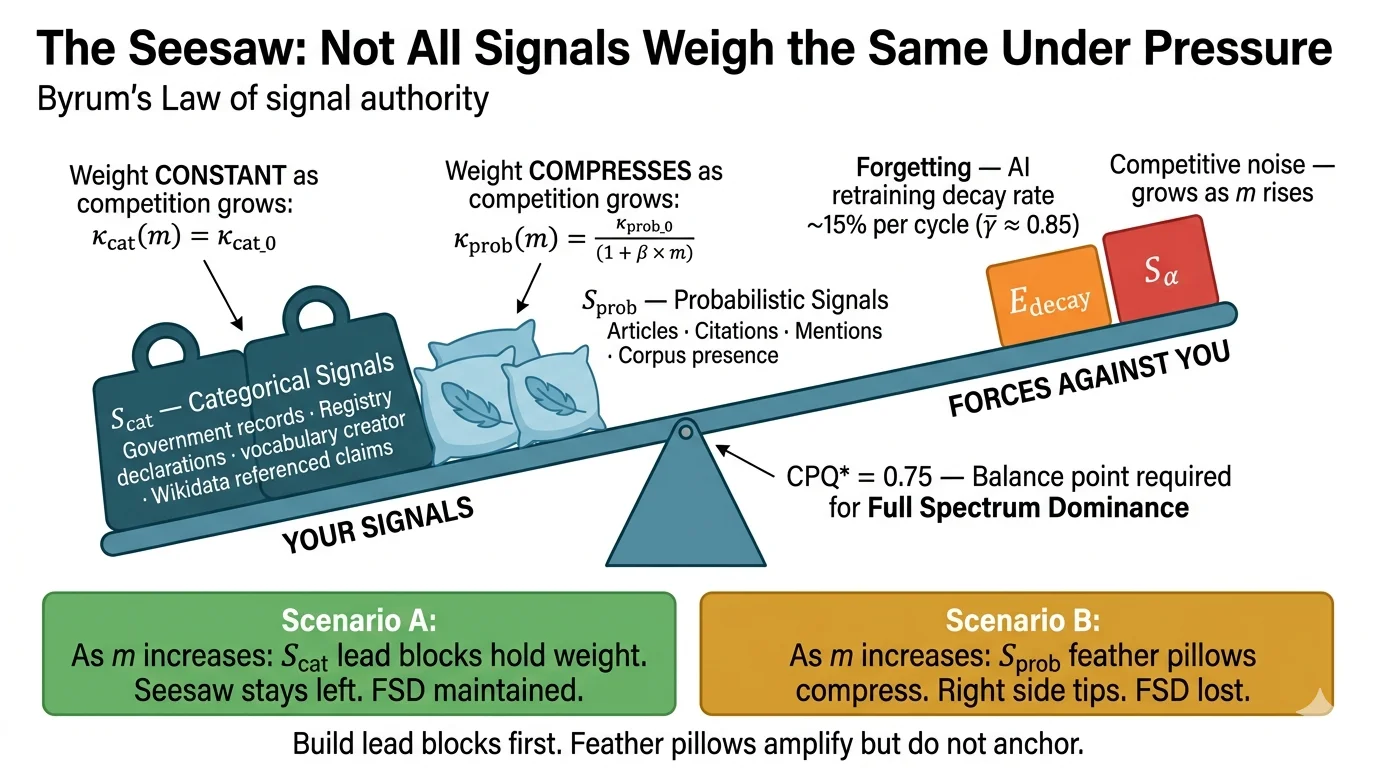
Temporal depth means how long your organization has appeared in AI training data. It creates a parametric weight advantage that attacks cannot erase. An adversary building signals today can’t change the fact that you started in 2010. The founder effect boost from deep temporal depth is immune to attack because it relies on years of prior training cycles, not current spending.
Ontological sovereignty works similarly. It means that formal sources confirm your organization as the origin of key terms. Once multiple sources teach an AI system that your company created a specific concept, changing that credit takes more than just creating competing signals. You must overwrite an existing proven record. The earlier you establish this credit, the harder it becomes to displace.
Everything else—breadth of citations, media mentions, third-party references—can be replaced by a well-funded adversary. Those signals reflect current investment, which can be matched. Only temporal depth and ontological sovereignty are immune. They come from time, not spending.
Why You Must Build AI Reputation Defenses Before the Attack
The hardest lesson from Theorem 4 is also the most uncomfortable: you must build defenses before an attack starts. You cannot build them during one.
This is not just strategy. It is a mathematical result of how weight dynamics work. During an attack, you try to build defensive signals while the adversary creates offsetting ones. The attacker focuses resources on a narrow area. The defender, building depth from scratch, cannot gain the time-based advantage that depth requires. Time cannot be rushed.

Every organization in a competitive market should invest in AI Adversarial Defense proactively, not react to attacks that have already begun. The organization’s structured data, authority database entries, and vocabulary declarations from Theorem 2 form the foundation of adversarial defense under Theorem 4. These same actions serve both offensive and defensive purposes.
How to Detect an Adversarial Attack on Your AI Presence

Theorem 4 describes a detection pattern that separates adversarial displacement from normal erosion. Three conditions must occur together. First, citation probability (CPQ) drops by more than 10 percentage points over two measurement periods. Second, the drop is concentrated in specific query types, not spread across categories. Third, the drop links to an identifiable event—like a competitor announcement, a publication, or a structured data campaign. Detecting early signs is critical for AI Adversarial Defense.
An organization that watches CPQ broadly but not by query type will miss adversarial displacement until it is advanced. The query-type focus is the signature of an attack versus natural erosion. Natural erosion spreads everywhere; adversarial displacement hits specific areas.
Most organizations do not measure CPQ by query type. They look at overall category presence—how often they appear in AI answers—instead of mapping to specific queries. This monitoring gap lets early-stage attacks go unnoticed until major damage is done.
Pre-Transition Attacks: Why Timing Matters for Adversaries
One of Theorem 4’s more advanced findings involves timing relative to AI model updates. When a major AI model is retrained or a new architecture appears, parametric weights from the prior epoch carry forward through what the Law calls the founder effect. Entities with deep temporal depth get a positive boost to their existing advantages. Pre-transition timing poses a unique challenge for AI Adversarial Defense.
An attacker who understands this can launch an attack just before a transition. They aim to reduce the target’s weight during that window. If successful, the attack gets amplified by the founder effect. The reduced weight moves into the new epoch at a lower level than it would have without the pre-transition strike. The attacker’s spending in that window can produce outsized long-term impact.
The defense stays the same: have enough temporal depth and ontological sovereignty before the transition. Then adversarial pre-transition attacks cannot push the target below a structural floor that the founder effect will amplify. Organizations with genuine deep temporal depth are protected against pre-transition attacks.
Confidence Level for Theorem 4
Theorem 4 was classified as VERDICT B after adversarial review. It is a formally correct Theorem 1 extension that governs the adversarial noise floor level, with CPQ floors mathematically derived from the temporal depth corollary. The theory is strong. Like all theorems in this family, field confirmation awaits the main falsification test. Theorem 4 is a cornerstone of AI Adversarial Defense theory.
Next in this series: Theorem 5 — The Unified Theorem. How one single rate law governs all scenarios: buyer domains, multi-category portfolios, adversarial conditions, and every architectural epoch.

Joseph Byrum is an accomplished executive leader, innovator, and cross-domain strategist with a proven track record of success across multiple industries.