Table of Contents
Every other part of digital marketing has a measurement tool. Search ranking has a dashboard. Social reach has analytics. Brand awareness has tracking surveys. AI authority hasn’t had one — until now. I built a measurement framework directly from the governing inequality I introduced in Article 1. This article explains why Citation Probability at Query (CPQ) is the right primary observable and defines the CPQ citation threshold. Then I’ll walk through the Entity Authority Score — a four‑component instrument for tracking it. Finally, I’ll lay out the threshold structure that decides when AI systems shift from hedging to real authority.
Why Is CPQ the Correct Primary Entity Authority Observable?

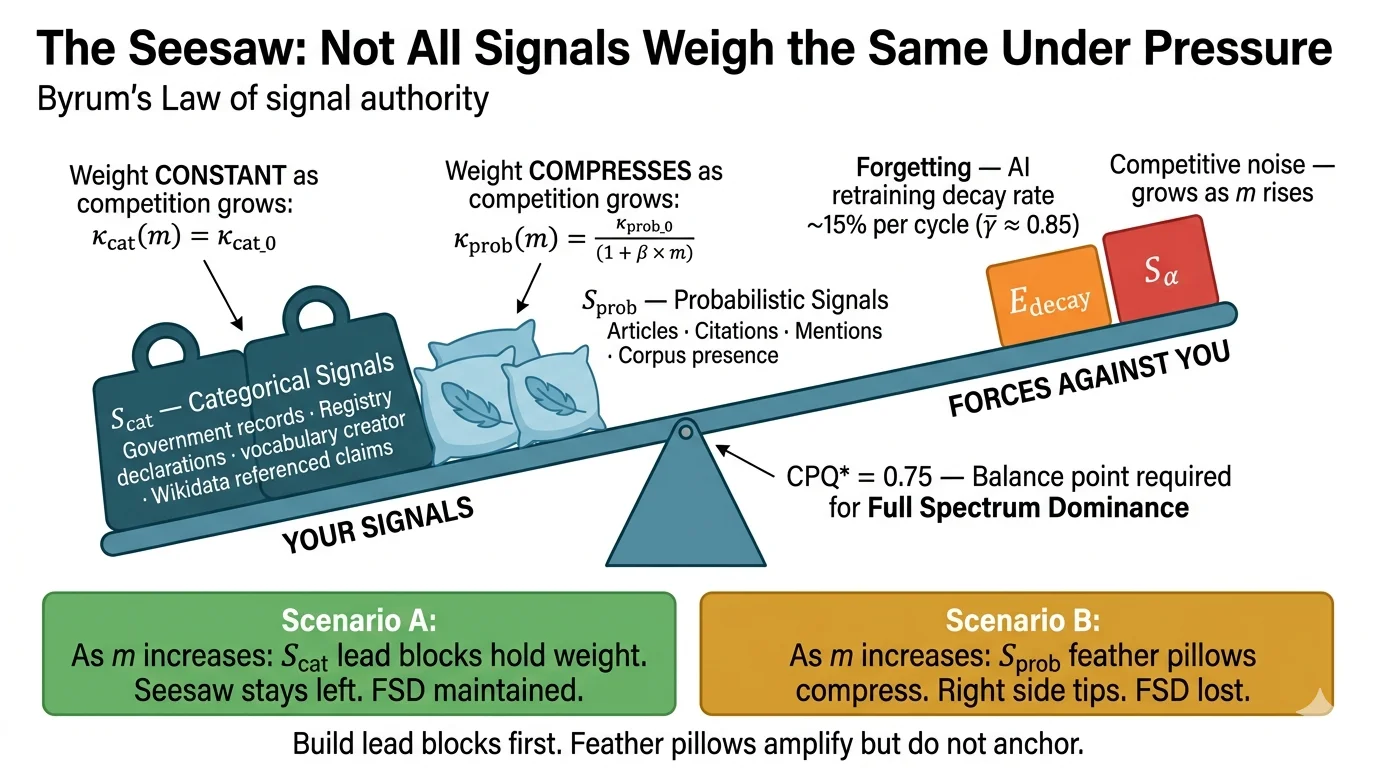
The governing inequality — Sε,flow + Sε,stock > Eε(γ) + Sα — makes a clear prediction. It predicts whether an AI system names your entity as the top authority when someone asks a category‑defining question. Any measurement tool that claims to track this prediction has to map back to that observable.
CPQ (Citation Probability at Query) is that observable. Here’s how I measure it. I submit n=26 queries to an AI platform. Then I count how many responses name my entity as the primary authority without hedging language.

Why 26? That’s the smallest sample size. It gives 80% statistical power at a 0.05 significance level. It detects CPQ differences of 0.15 or more. This works with a binary outcome.
The key structural feature that sets CPQ apart from simpler metrics (like “does your company appear in AI results?”) is the threshold structure. At CPQ* = 0.75, a clear jump happens: hedging language disappears. Below that threshold, responses include qualifiers — “reportedly,” “according to some sources,” “may be the leading.” Above it, the entity gets cited as an unqualified authority. That CPQ citation threshold isn’t arbitrary. It matches the point where the model’s internal confidence estimate crosses the line for unhedged assertion. I call this the CPQ Citation Threshold. This threshold is the line between hedged and unhedged citation. The CPQ citation threshold marks a key turning point in AI citation behavior.
| DEFINED TERM | CPQ Citation Threshold |
|---|---|
| Definition | The CPQ value (estimated at 0.75, prior range 0.65–0.85). At this value, AI systems switch from hedged citation (“reportedly,” “claims to be”) to unhedged authority citation. The CPQ citation threshold represents the model’s internal confidence crossing the point needed for unqualified assertion. Below it, the entity lives in a state of doubt about its status — no matter its actual market position. Above it, the entity has achieved Ontological Dominance. |
| Formula | CPQ* ≈ 0.75 (prior range: 0.65–0.85) |
The behavior of CPQ near the CPQ citation threshold isn’t linear. I define the dynamics that govern this threshold‑crossing behavior as “Confidence Threshold Dynamics — AI Citation Behavior.” It’s the abrupt switch in AI citation language at CPQ* — a binary change from hedged to unhedged, not a gradual shift.
This matters for measurement. A small improvement in CPQ above 0.70 can produce a big jump in AI citation quality. That happens if it pushes you past the CPQ citation threshold.
| DEFINED TERM | Confidence Threshold Dynamics — AI Citation Behavior |
|---|---|
| Definition | The abrupt switch in AI citation behavior at CPQ* — a binary categorical change at the confidence threshold, not a gradual shift. An entity just below CPQ* behaves differently than one just above it, even if the CPQ difference is tiny. This non‑linearity means small infrastructure improvements near the threshold can produce large changes in citation behavior. |
| Formula | CPQ → CPQ*: hedged citation → unhedged citation (binary switch, not a dial) |
What Are the Four Components of the Entity Authority Score?

CPQ is the right primary observable, but measuring it directly across every competitive context takes structured query campaigns. For ongoing monitoring and diagnosis, I’ve developed the Entity Authority Score. It is a composite proxy from the four structural parts of the governing inequality.
| DEFINED TERM | Entity Authority Score (EAS) |
|---|---|
| Definition | A composite measure of entity authority across the four structural components of Byrum’s Dominance Inequality, scored out of 100 points. Component I_E (Identity Completeness, 25 pts) tracks structured data validity, authority database presence, and persistent identifier chains. Component A_E (Attribute Accuracy, 25 pts) tracks structured data attribute correctness and support. Component M_E (Machine Readability, 25 pts) tracks structured data deployment and completeness. Component O_E (Ontological Authority, 25 pts) tracks vocabulary attribution and lexicon ownership. |
| Formula | EAS = I_E + A_E + M_E + O_E (0–100 pts) |
Each component maps to one of the four terms in the governing inequality. I_E and A_E together drive the identity coherence and attribute accuracy that make Sε,flow effective. M_E is the amplifier coefficient for Sε,flow — structured data gaps reduce how fast new signal construction converts to parametric weight. O_E maps to the vocabulary sovereignty part of Sε,stock. The connection between EAS and CPQ isn’t a simple linear mapping — it’s a theoretically grounded proxy. Higher EAS systematically predicts higher CPQ within the right scope conditions.
Entity Authority Score (EAS)

| DEFINED TERM | Authority Equation |
|---|---|
| Definition | The functional relationship shows that Algorithmic Authority depends on four inputs in order |

Joseph Byrum is an accomplished executive leader, innovator, and cross-domain strategist with a proven track record of success across multiple industries.