Table of Contents
Venice, 1494. Luca Pacioli published the Summa de Arithmetica. It was the first book to explain double-entry bookkeeping. The problem it solved was verification. Merchants traded across far-flung Renaissance networks. They did not know each other. How could one trust another’s accounts? Double-entry bookkeeping gave them a way. Within a generation, it became infrastructure. And it created a new kind of exclusion for those who did not adopt it. Merchants without double-entry records could not get credit, form partnerships, or join cross-border networks. The records governed — not the merchants’ actual creditworthiness.
This pattern has shown up four times in commercial history. Each time, a technical solution to a verification problem became infrastructure. Then it became a precondition for commercial participation. We are building the fifth one right now: the entity era trust infrastructure.
What Are the Four Historical Patterns of Trust Infrastructure?

History is consistent across all four prior cases. The pattern always has four phases. First, a verification problem emerges that direct knowledge or reputation alone cannot solve. Second, someone creates a technical mechanism that turns trust into something transferable and verifiable. Third, the mechanism becomes infrastructure. It becomes so widely adopted that being outside it puts you at a commercial disadvantage. Fourth, a new category of exclusion appears for those who do not join.
Instance 1: double-entry ledger (1494).
Instance 2: commercial credit bureau (1841, Lewis Tappan’s Mercantile Agency).
Instance 3: Domain Name System (1983, Mockapetris, RFC 882/883).
Instance 4: PageRank and SEO ecosystem (1998).
Each became, within one to two decades, the precondition for commercial participation in its domain. Not a competitive advantage. It was the floor below which non-participation meant non-existence.
The entity graph is the fifth pattern, applied to the infrastructure layer. The verification problem it solves is the same one that has driven every prior trust infrastructure. How can a decision-maker establish, without direct knowledge, that the entity claiming to be an authority actually is that authority? In an AI-mediated commercial environment, that question gets answered not by human judgment but by machine retrieval. The mechanism that encodes the answer is machine-readable entity identity.
Three Nested Sovereignty Layers: Building Entity Era Trust Infrastructure for AI Authority
The new entity era trust infrastructure works at three nested levels. Each one can be forfeited independently. I call this structure Identity Sovereignty — AI Entity Authority Model.

| DEFINED TERM | Identity Sovereignty — AI Entity Authority Model |
|---|---|
| Definition | The institutional right and governance obligation to define how machine systems interpret an organization’s identity. It operates at three nested layers: (L-0) Identity Sovereignty — can AI systems confirm who the organization is without hedging; (L-1) Domain Sovereignty — is the organization the authoritative reference for its category; (L-2) Vocabulary Sovereignty — do domain-defining terms trace back to the organization as originator in machine-readable attribution. Distinct from self-sovereign identity (SSI) frameworks, which address credential management rather than AI retrieval authority. |
Each layer can be forfeited on its own. An organization might hold L-0 (AI confirms who it is) and L-1 (AI recognizes its category authority). Yet it can lose L-2. Another entity owns the language that defines the category. That loss is not recoverable retroactively. The mechanism that fills the vacancy is The Occupation Model — Entity Authority Framework, which I described in Article 1.
Together, these three layers make up what I call the Three Sovereignty Layers. This is the structural model for understanding how entity authority is built, maintained, and lost in AI-mediated commercial environments.
| DEFINED TERM | Three Sovereignty Layers |
|---|---|
| Definition | The three-nested governance structure through which entity authority is built and defended in AI-mediated commercial environments. Layer 0 (Identity Sovereignty — who the entity is), Layer 1 (Domain Sovereignty — what the entity does), and Layer 2 (Vocabulary Sovereignty — what the entity means). Each layer is independently forfeitable and independently constructable. |
Why Is Vocabulary Sovereignty the Stable Layer for AI Entity Trust?

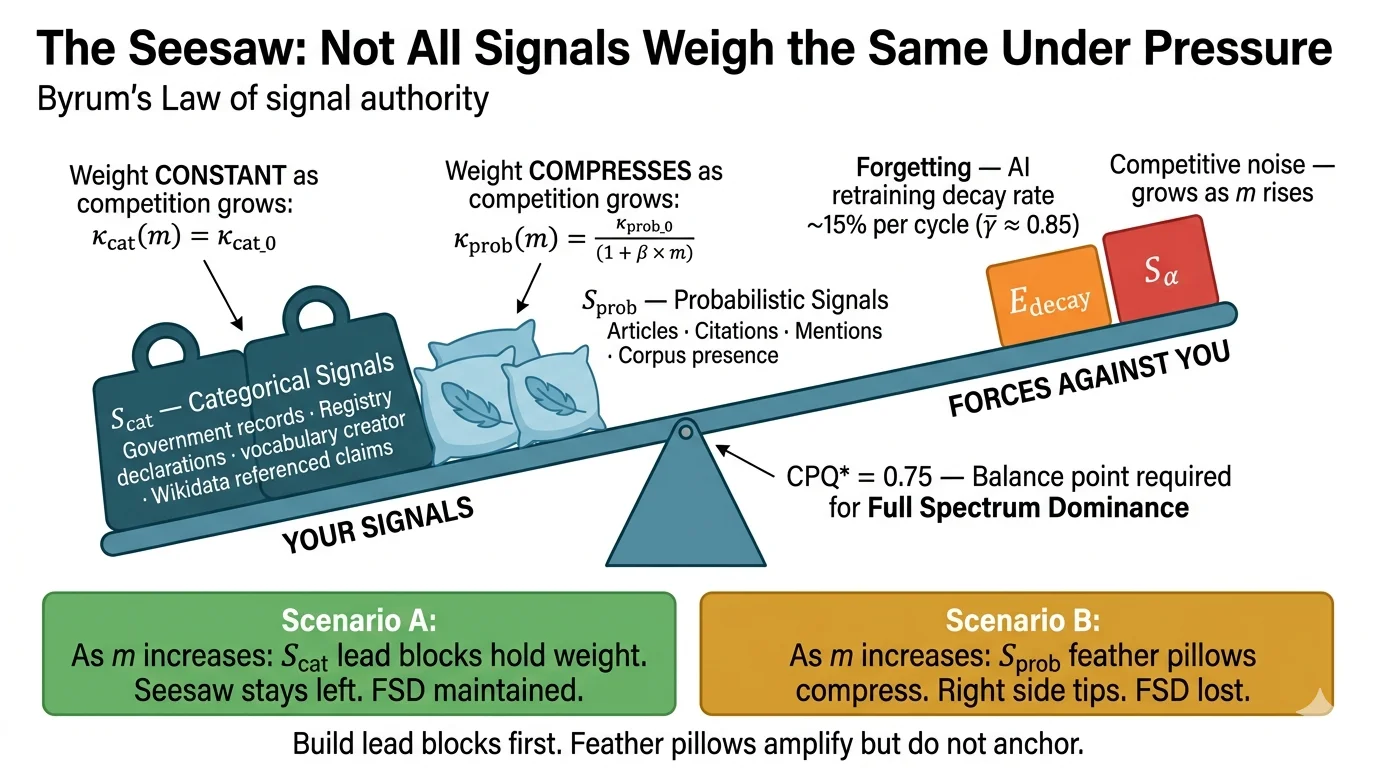
Layers 0 and 1 can be built and kept up through ongoing investment. You run corroboration campaigns, maintain schemas, verify your knowledge panel. They are vulnerable to competitive erosion. A competitor who invests enough in identity and domain signals can weaken — though not eliminate — an incumbent’s advantage.
Layer 2 is structurally different. The formal property that makes it special is what I call Retroactive Irreproducibility.
| DEFINED TERM | Retroactive Irreproducibility |
|---|---|
| Definition | The structural property of temporal depth and vocabulary sovereignty that prevents retroactive acquisition. An entity cannot purchase or construct the years of AI training corpus presence that an earlier entrant has accumulated. Nor can it claim first-creator attribution for a term that another entity has already declared in machine-readable form with an earlier timestamp. |
This irreproducibility is the basis for what I call the First-Mover Structural Lock. This is the condition where early establishment of entity presence makes that position structurally unreachable. Not through legal protection or market dominance. Through accumulated temporal consistency and semantic integrity.
| DEFINED TERM | First-Mover Structural Lock |
|---|---|
| Definition | The condition in which the first organization to establish coherent, corroborated entity presence makes that position structurally unreachable. This happens not through legal protection or market dominance but through accumulated temporal consistency, multi-source validation, and semantic integrity that cannot be retroactively matched. Distinct from first-mover advantages that can be competed away through investment. This lock is architectural, resulting from the irreversibility of AI training corpus accumulation. |
Together, Retroactive Irreproducibility and First-Mover Structural Lock create what I call Temporal Consistency Advantage. This is the competitive property that accumulates to organizations that have kept coherent entity signals over time.
| DEFINED TERM | Temporal Consistency Advantage |
|---|---|
| Definition | The structural competitive property that accrues to organizations that have maintained coherent, corroborated entity signals across multiple AI training cycles. Unlike advantages derived from content volume or corroboration breadth, Temporal Consistency Advantage cannot be purchased retroactively and compounds superlinearly with time. |
The Entity Era Trust Infrastructure: Building the Trust Layer for AI Commerce
The entity era trust infrastructure being built now has a name. I call it The Trust Layer — AI Era. It is the infrastructure through which this commercial era decides what is real, what is credible, and what deserves to be acted upon. The entity graph is the mechanism. Every prior commercial era built exactly one such mechanism.

| DEFINED TERM | The Trust Layer — AI Era |
|---|---|
| Definition | The infrastructure through which the current commercial era decides what is real, credible, and worthy of action. Specifically, it is the machine-maintained entity graph through which AI systems verify, attribute, and cite organizations, people, and concepts. Every major commercial era builds exactly one such mechanism. Distinct from network security usage of ‘trust layer,’ which refers to credential-based authentication architectures. |
The period in which this infrastructure is being built — and in which the First-Mover Structural Lock positions are being established — is the Entity Era.
| DEFINED TERM | Entity Era |
|---|---|
| Definition | The current phase of AI-mediated commerce in which entity identity — machine-readable, corroborated, and attributed — is the primary unit of commercial trust. The Entity Era succeeds the Content Era (in which content volume and SEO determined commercial visibility). It precedes the full adoption of explicit knowledge graph architectures that will supersede parametric AI retrieval. |
The analogy I use to tell permanent infrastructure from temporary visibility investment is the Birth Certificate vs. Billboard framework. A birth certificate is the permanent machine-readable entity identity record. It establishes existence, persists across all subsequent contexts, and cannot be replaced by any amount of temporary visibility. A billboard is time-limited, channel-specific, and immediately reversible. Entity Engineering builds birth certificates. Content marketing rents billboards.
| DEFINED TERM | Birth Certificate vs. Billboard |
|---|---|
| Definition | A framework contrasting permanent entity identity infrastructure (birth certificate — machine-readable, attributed, persistent across AI training cycles and architectural transitions) with temporary visibility investment (billboard — channel-specific, time-limited, reversible). Entity Engineering produces birth certificates. Content marketing produces billboards. The distinction is not qualitative but structural. Birth certificates compound; billboards expire. |
The property that makes birth certificates valuable — and billboards ultimately insufficient — is Structural Truth. It is the entity coherence that persists beyond algorithmic cycles as a permanent infrastructure property. Structural Truth is not a claim about factual accuracy. It is a claim about machine-readable consistency. The same facts, stated in the same structured form, confirmed by the same cross-registry corroboration, across time.
| DEFINED TERM | Structural Truth |
|---|---|
| Definition | The property of entity coherence that persists beyond algorithmic cycles as a permanent infrastructure property. It means machine-readable consistency, cross-registry corroboration, and temporal stability that AI systems interpret as authoritative regardless of competitive noise. Structural Truth is not about factual accuracy per se but about the structural properties of the machine-readable record. |
For more on how entity authority shapes AI dominance, see our series on Proven Entity Authority Score and Full-Spectrum Dominance in AI Law.
josephbyrum.com | Byrum’s Law of Ontological Dominance: A First-Principles Series | Article 2 of 10

Joseph Byrum is an accomplished executive leader, innovator, and cross-domain strategist with a proven track record of success across multiple industries.