Table of Contents
Publishing this framework opens up more attack possibilities in ontological warfare. Every organization that learns how to build AI entity authority from this series also learns, by implication, how to mess with a competitor’s. That doesn’t mean we should hide the framework. It means we need to be crystal clear about the attack types and the defenses. This article names the three attack vectors in ontological warfare, describes each one formally, and spells out what a solid defense looks like for each. Ontological warfare is not optional. Every entity that exists in AI‑mediated markets is already participating, whether they know it or not. Understanding the attack vectors is the only way to defend yourself.
What Are the Three Attack Vectors on Entity Authority?

Three distinct attack classes threaten entity authority. They differ in timelines, cost structures, detection needs, and defense architectures. They’re not interchangeable. A defense that works for one won’t cover the others.
T-1 is Conflation Engineering, covered in detail in Article 6. It’s the deliberate injection of false-attribution signals. The goal is creating parametric ambiguity.
- Timeline: weeks (a single training cycle).
- Cost asymmetry: strongly favors the attacker.
- Detection: needs active CPQ monitoring.
- Defense: pre‑emptive identity perimeter hardening.
T-2 is Vocabulary Displacement: trying to claim first‑creator credit for a target’s coined terms in machine‑readable structured data before the target gets there. Or flooding the corpus with competing definitions to weaken the target’s IDF weight. Covered by the vocabulary sovereignty framework in Article 8.
- Timeline: months (needs multiple training cycles to accumulate).
- Cost asymmetry: moderate. The attack requires structured data deployment, not just content flooding.
- Detection: needs monitoring of IDF scores and first‑creator attribution for owned vocabulary.
- Defense: pre‑registration before going public.
T-3 is Temporal Depth Denial: trying to suppress or delist a target’s historical machine‑readable records. Things like web archive removal, structured data deprecation campaigns, or DOI/URI poisoning. The goal is shrinking the target’s effective temporal depth in AI training corpora.
- Timeline: long‑term (needs historical record degradation over time).
- Cost asymmetry: near‑neutral. The defense is as tough as the attack.
- Detection: needs audit of web archive coverage and persistent identifier integrity.
- Defense: multi‑source historical record redundancy and cryptographically signed publication timestamps.
In ontological warfare, attackers choose their vector based on their resources and the target’s vulnerabilities. T-1 attacks are cheap and fast, so they are common first strikes. T-2 attacks require more planning but can permanently damage a brand’s ownership of its own terms. T-3 attacks take years but can erase a company’s historical record, making it invisible to future AI systems. Understanding these vectors is the first step to building a defense.
Ontological warfare uses these three vectors to compete for AI‑mediated entity authority. The attacker picks the vector that matches their resources and timeline.
Full Spectrum Dominance: The Ultimate Defense in Ontological Warfare
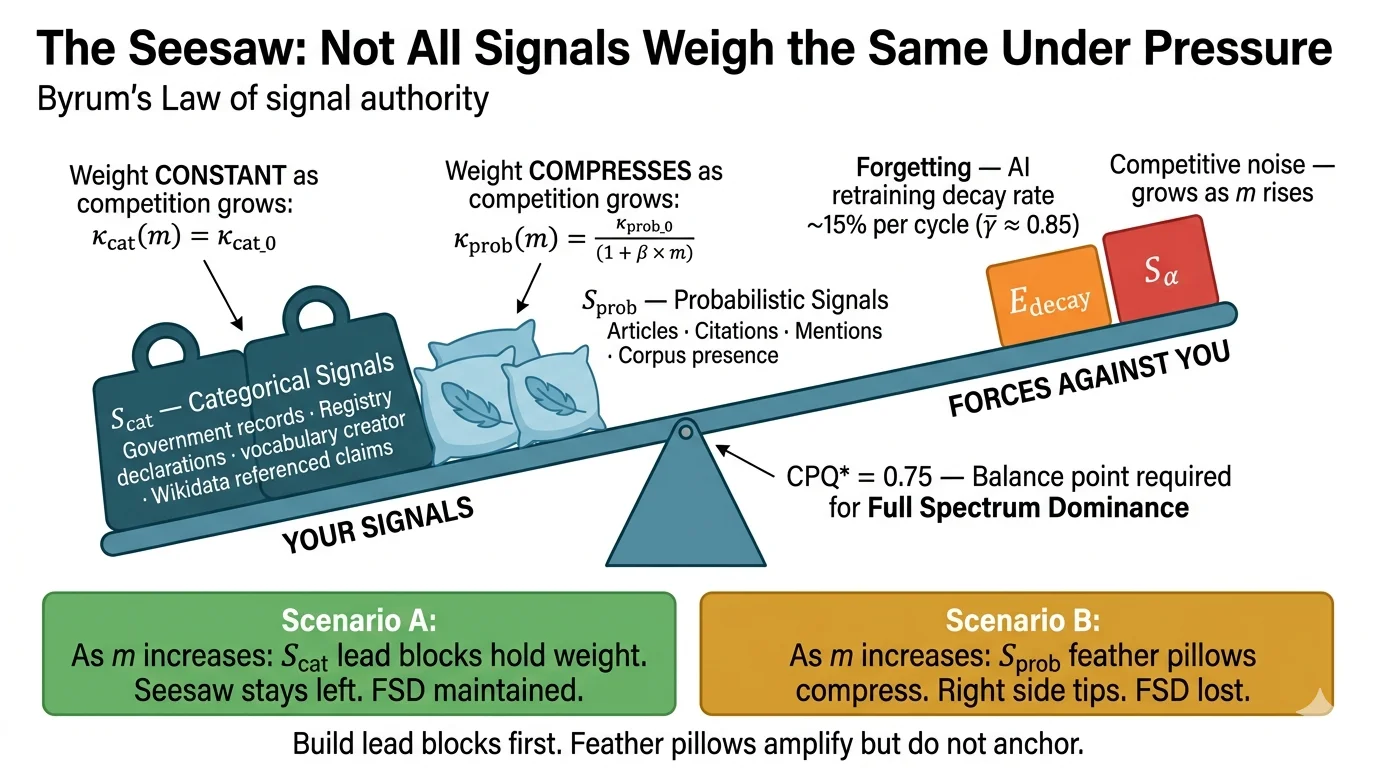
The defended end state is being present on all three sovereignty perimeters at once, with no exploitable gaps across all three attack vectors. I call this Full Spectrum Dominance — AI Entity Authority. It means you simultaneously hold Machine‑Confirmed Identity (L‑0), Domain Sovereignty (L‑1), and Vocabulary Sovereignty (L‑2). You also stay robust against all three attack classes.

| DEFINED TERM | Full Spectrum Dominance — AI Entity Authority |
|---|---|
| Definition | The condition is simultaneously maintaining Machine‑Confirmed Identity (L‑0), Domain Sovereignty (L‑1), and Vocabulary Sovereignty (L‑2) across all AI systems that mediate relevant commercial decisions. It also requires strong defenses against T‑1 (Conflation Engineering), T‑2 (Vocabulary Displacement), and T‑3 (Parametric Degradation) attack vectors. Full Spectrum Dominance isn’t a once‑and‑done achievement. It’s a condition you have to keep monitoring and defending. Full Spectrum Dominance in this context is distinct from military doctrine uses (Joint Vision 2010). It also differs from generic marketing usage meaning ‘integrated campaign across platforms.’ |
Achieving Full Spectrum Dominance in ontological warfare means you have closed all three attack vectors. Your identity is locked in, your vocabulary is claimed, and your history is preserved. This is the ultimate goal for any organization competing for AI entity authority.
What Is Ontological Warfare in AI Entity Competition?

The strategic competition for AI‑mediated entity authority is a whole new domain of competitive strategy. In this competition, entities deliberately engineer AI citation patterns to push competitors out while protecting their own position. I call it Ontological Warfare — AI Entity Competition. Ontological warfare focuses on controlling how AI systems perceive and cite entities. The stakes are high. In an AI‑mediated economy, being cited correctly by AI systems directly impacts revenue, reputation, and market position. Ontological warfare is the struggle to control that citation.
| DEFINED TERM | Ontological Warfare — AI Entity Competition |
|---|---|
| Definition | The strategic competition for AI‑mediated entity authority involves organizations deliberately building and defending AI citation patterns. They use signal construction, vocabulary sovereignty establishment, identity perimeter hardening, and adversarial disruption to achieve and hold category authority while displacing or disrupting competitors’ authority. In the AI entity competition context; distinct from philosophical and geopolitical uses of ‘ontological warfare’ (including Russian geopolitical theory), which address different phenomena. |
The threat surface that controls how intense ontological warfare gets in any category depends on how widely the framework is adopted. It grows as more entities learn the governing inequality. That’s the adaptive adversary dynamic. Once adversaries understand the inequality, they’ll optimize against it. The defense has to anticipate that adaptation.
Defending the Three Sovereignty Perimeters in Ontological Warfare
The Three Sovereignty Layers from Article 2 each line up with a specific attack surface and a specific defense posture. I formalize the governance structure for checking each perimeter independently as the Sovereignty Perimeters framework.

- Defense against T‑1: the identity perimeter — complete sameAs chain, authority database persistence, Machine‑Confirmed Identity across all registries.
- Defense against T‑2: the vocabulary perimeter — pre‑registration before public exposure, cross‑registry corroboration, Bi‑Temporal Provenance dating.
- Defense against T‑3: the temporal depth perimeter — multi‑source historical record redundancy, persistent identifier integrity, web archive coverage.
Each perimeter must be monitored continuously. The threat landscape shifts as AI systems evolve. What works today may not work tomorrow. Regular audits and updates are essential to maintain your defenses in ontological warfare.
All three perimeters need independent assessment and maintenance. A gap in any one creates an exploitable attack surface. It doesn’t matter how strong the other two are.
The AI Training Phase Boundary: Strategic Impact on Entity Authority
The Architectural Phase Boundary — AI Training Systems is the transition point between the current parametric LLM era and the emerging world‑model / explicit knowledge graph era. Its strategic implication for the attack taxonomy is big. At that boundary, the primary attack vector shifts from parametric manipulation (T‑1 Conflation Engineering) to knowledge graph poisoning and explicit record manipulation.
| DEFINED TERM | Architectural Phase Boundary — AI Training Systems |
|---|---|
| Definition | The Architectural Phase Boundary is the transition point between two epochs: the current parametric LLM epoch and the emerging explicit knowledge representation epoch. In the current epoch, entity knowledge is encoded in model weights during training and decays between cycles. In the emerging epoch, entity knowledge is stored in retrievable knowledge graphs with persistent records. At the phase boundary, the governing inequality changes form — from a rate inequality to a completeness threshold. The primary adversarial attack surface shifts from parametric manipulation to knowledge graph integrity. In the AI training systems context; distinct from thermodynamic and material science uses of ‘phase boundary.’ |
The strategic takeaway for the attack taxonomy is clear. Entities that build strong vocabulary sovereignty and temporal depth before the phase transition enter the new era with initialization advantages. Adversaries can’t retroactively undo those advantages. The First‑Mover Structural Lock from Article 2 is epoch‑transferable. Build now — before the epoch transition — and that structural lock carries forward. This is why ontological warfare demands early action. Waiting until the epoch transition means you have already lost the initialization advantage.
Using the Three Sovereignty Layers to Govern Entity Authority
The Three Sovereignty Layers — formally introduced in Article 2 and extended here — give us the operational governance framework for managing the three perimeters against the three attack vectors. Each layer governs a distinct set of signal construction, monitoring, and defense activities. The governance obligation isn’t symmetrical. Layer 2 (Vocabulary Sovereignty) requires pre‑registration before public exposure — a timing constraint the other layers don’t have. Once a term is circulating publicly without a machine‑readable creator claim, the window for first‑mover attribution starts closing. Ontological warfare demands that timing discipline. The three sovereignty layers provide a structured approach to governance. Layer 0 (Machine-Confirmed Identity) ensures your entity is recognized correctly. Layer 1 (Domain Sovereignty) secures your digital territory. Layer 2 (Vocabulary Sovereignty) protects your unique terms. Together, these layers form a complete defense against all three attack vectors in ontological warfare.
josephbyrum.com | Byrum’s Law of Ontological Dominance: A First‑Principles Series | Article 9 of 10

Joseph Byrum is an accomplished executive leader, innovator, and cross-domain strategist with a proven track record of success across multiple industries.