Table of Contents
What Makes the World Model AI Theorem Unique?

Every theorem in Byrum’s Law before this one deals with the AI architecture we have right now—not the World Model AI, a fundamentally different paradigm. In these systems, organizational knowledge lives in distributed parametric weights. Those are patterns scattered across the model’s internal math. The AI absorbs that knowledge from training data, but it fades between training cycles. You retrieve it through probabilistic inference. That’s how today’s AI works. The rate condition that governs authority in this architecture is now triple-confirmed across three independent mathematical traditions. This theorem sets the stage for the future of AI authority.
Theorem 9 is different. It tackles an architecture that doesn’t yet exist at scale: the World Model. This is a fundamentally different AI paradigm. Knowledge isn’t stored as distributed parametric weights. Instead, it lives in explicit, structured knowledge graph records. Think of it as AI that keeps a formal, queryable database of facts about the world. It does not absorb those facts into mathematical weights.
Leading AI researchers, including Yann LeCun of Meta AI, see World Model architectures as the likely next major shift. The projected timeline is roughly 2035 to 2040. Theorem 9 is a Prospective Formal Framework. It is a formally derived theoretical structure for a future scenario we can’t test yet. This is the first theorem in the Law with a verdict of VERDICT C: prospective.
Why Byrum’s Law Stops at the World Model Boundary
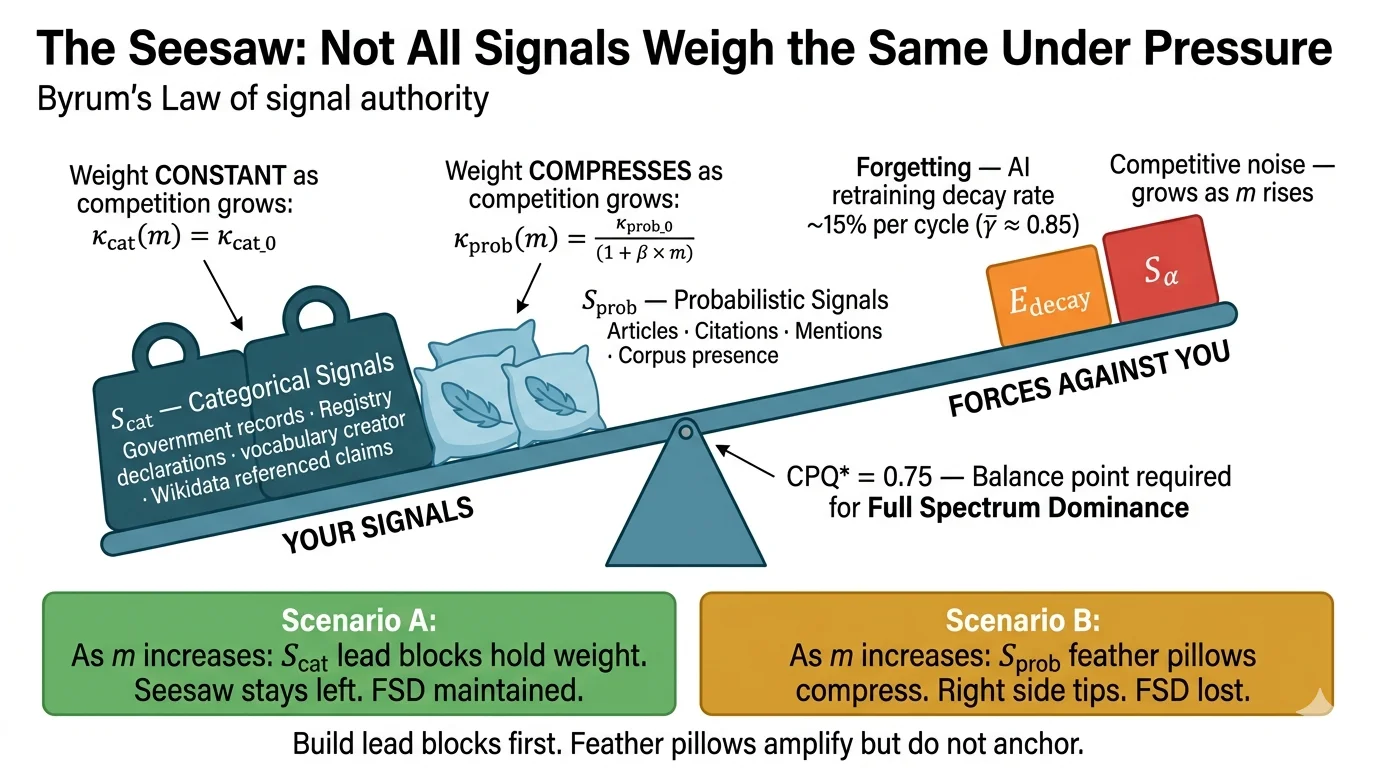
The transition from current architectures to World Models involves a fundamental change in how knowledge is stored and maintained. Here’s where the math gets interesting. As AI architectures move toward the World Model paradigm, Byrum’s Law’s rate condition goes through a phase transition. In the current architecture, the competitive decay rate is governed by a parameter called gamma-bar. It shows how much parametric weight an entity loses per training cycle. As World Model architectures approach completion, this parameter approaches 1. That means no decay. A complete, accurate World Model record persists indefinitely. You don’t need to keep building signals to maintain it.
When this parameter hits exactly 1 in a World Model context, the rate condition degenerates. The condition says signal construction must outpace decay plus competitive noise. It becomes “0 must exceed 0.” That is trivially satisfied and formally meaningless. The Law’s governing mechanism no longer applies.

This is not a flaw in the Law. It is a formally predicted boundary condition. Byrum’s Law governs parametric encoding architectures. At the boundary of that architecture, when World Model systems deploy, the Law formally states where its own domain ends. That is what a mature theoretical framework should do. It clearly states its scope. It identifies the boundary where those conditions stop holding. This boundary is a natural feature of any well-defined theoretical framework—it knows its limits.
Knowledge Graph Completeness Threshold in World Models

In a World Model architecture, authority is not set by your signal construction rate. It is set by knowledge graph completeness. Instead of asking whether an entity’s signal construction rate exceeds the decay-adjusted entropy threshold, the World Model asks a different question. It asks whether the entity’s knowledge graph record is complete, accurate, and connected to relevant context.
Theorem 9 formalizes the completeness threshold concept. An entity achieves authoritative representation in a World Model architecture when its knowledge graph completeness score exceeds a specified threshold. That threshold is currently estimated at 90% completeness. Below that threshold, the record has gaps. The AI system can’t fill them through inference. So you get hedged or incomplete representation. Above it, the record is complete enough. The AI system can answer queries about the entity accurately and without hedging.
The completeness threshold has three parts. First, the entity must have a complete, accurate structured record. All attributes must be correctly specified and corroborated. Second, that record must be accurate. It must be not just present but correct. A World Model that cites accurate facts about your organization still needs those facts to be true. Third, the record must maintain adversarial integrity. A complete World Model record can be damaged by adversarial modifications. Maintaining integrity against those attacks is a new form of the adversarial integrity condition from Theorem 1. This third condition ensures that the record remains trustworthy even under attempts to corrupt it. This threshold is not arbitrary; it emerges from the formal analysis of how World Models process information completeness.
How Theorem 2 Prepares You for World Models Today
Here is the finding that makes Theorem 9 significant for organizations today. Even though World Model architectures won’t deploy at scale for another decade, the required actions are identical. Specifically, the actions you need to take to prepare for a World Model future are the same actions required to achieve Accurate Specific Representation (Theorem 2) in today’s architecture.
Complete your structured data. Get every required and recommended attribute accurately specified. Verify and complete your authority database entries. Declare your coined vocabulary. Establish cross-references connecting your structured data across platforms.

Those are the Theorem 2 actions. They are also the Theorem 9 preparation actions. Thus, the same effort serves dual purposes across different architectural eras. An organization that completes them this year to improve its CPQ on today’s AI systems is simultaneously preparing its knowledge graph record. That record will be ready for World Model architectures that may deploy in the 2030s. This comes at no extra cost and with no extra work.
Conversely, an organization that delays these actions because World Models are too far in the future is also failing. It fails to take actions that would improve its representation on today’s AI systems. The preparation is not future-oriented at the cost of present performance. It is the same investment serving both present and future performance.
Permanent First-Mover Edge in the World Model Era

Theorem 9 identifies a structural first-mover advantage in World Model preparation. This advantage has no analog in current parametric architectures. In today’s systems, early movers gain temporal depth advantages. Their longer history in the training corpus produces higher parametric weight. But temporal depth, once established, can still be approached over time by organizations that build signals consistently.
In a World Model architecture, the first organizations to achieve knowledge graph completeness above the threshold will establish structured records. Once verified and absorbed into the World Model, those records persist without decay. A competitor who achieves completeness one year after you can’t close the gap by outspending you. The completed record is already there. The first-mover advantage in World Model completeness is even more durable than the temporal depth advantage in current architectures.
This creates a race dynamic that Theorem 9 explicitly acknowledges. Organizations that understand the World Model transition will race to achieve knowledge graph completeness before deployment. Early completers gain permanent first-mover advantages in the World Model epoch. Late completers face a persistent disadvantage. Once established, that disadvantage can’t be closed regardless of investment level. The window of opportunity is open now, and it will eventually close.
Action: Complete Structured Data for World Model Readiness
The answer is simple. I have said it throughout this series. Complete your structured data. Authority database. Vocabulary declarations. These actions improve your current AI representation. They serve as the defensive foundation against adversarial attacks. They prepare you for architectural epoch transitions. They position you for the World Model era. In essence, structured data completeness is the common thread across all epochs.
There is no tension between present-epoch optimization and future-epoch preparation. They are the same program. The only question is whether you do it now, when the competitive landscape is still relatively open. Or later, when competitors who understood this earlier have already staked their claims.
Why Is Theorem 9 a Prospective Formal Framework?
Theorem 9 holds a unique formal status: VERDICT C—Prospective Formal Framework. The phase transition at the World Model architecture boundary is confirmed by dual mathematical derivation. This includes Lyapunov stability theory and Pontryagin optimal control analysis. The prospective formal framework includes the knowledge graph completeness threshold, the completeness conditions, and the first-mover dynamics. It is formally derived but can’t be empirically tested until World Model architectures deploy at scale.
That is the honest scientific status of a theorem about a future architecture. The theoretical result is formally established. The empirical test can’t be run yet. The practical implication is actionable today. Complete your structured data. It is the single most important step you can take today. This remains the correct action regardless of whether World Model systems deploy on the projected timeline.
The journey through these nine theorems has shown that authority in AI is not a mystery—it is a structured property that can be systematically built.
This concludes the nine-theorem series on Byrum’s Law of Ontological Dominance. Check back soon for the full formal specification including all mathematical derivations, audit findings, and empirical roadmap.

Joseph Byrum is an accomplished executive leader, innovator, and cross-domain strategist with a proven track record of success across multiple industries.