Table of Contents
How Does the AI Epoch Transition Reset Competitive Landscapes?

The AI landscape does not evolve smoothly. It advances through AI epoch transitions — the shift from one generation of AI architecture to the next. Think GPT-3 giving way to GPT-4, or a new foundation model replacing an older one as the main way AI finds and retrieves information. Each of these AI epoch transitions is a big break in the competitive landscape.
Most organizations treat these AI epoch transitions as outside events. They react afterward. Theorem 6 shows that this approach is wrong — because the position you hold right before an AI epoch transition gets amplified, not reset. Organizations that have built deep temporal depth and strong parametric weight before an AI epoch transition enter the new epoch with an amplified advantage. Organizations that have not fall even further behind in the new epoch than they were in the old one.
Theorem 6 — the Epoch Extension of Byrum’s Law — explains how AI epoch transitions work. It also gives the right management steps for handling them.
Founder Effect: Why Pre-Transition Boosts Epoch Advantage
Theorem 6 works through founder effect amplification. When a new AI architecture trains on its first data, the relative parametric weights of entities from the old epoch carry forward. Entities that had higher parametric weight in the old epoch get higher initial parametric weight in the new one. Not because of what they do during the transition — but because of what they did before it.
More precisely, the amplification factor for an entity at an AI epoch transition is proportional to the ratio of its temporal depth advantage to the average. Say an organization has ten years of consistent, machine-readable authority signals. The average organization in its category has three years. That organization enters the new epoch with a parametric advantage amplified relative to that ratio. The mathematics are not linear — the advantage compounds.

This means the investment you make in the two to three years before a major AI epoch transition gives you high returns compared to the same investment made during a stable period. Pre-transition signal construction front-loading — boosting your signal construction rate before an expected AI epoch transition — is a formally prescribed strategy.
Signal Substrate Stability: Not All Signals Survive Epochs

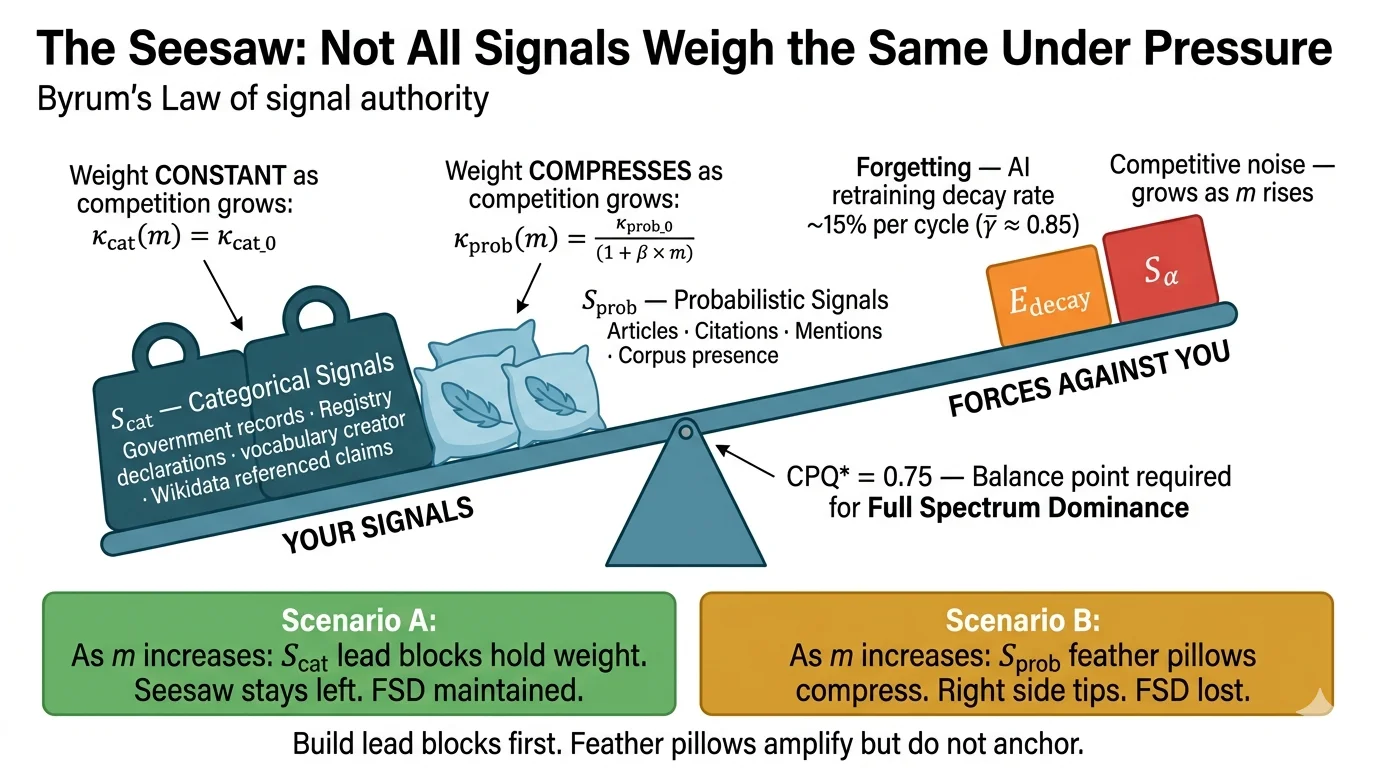
Theorem 6 introduces a key idea: signal substrate stability. Some authority signals are architecture-stable. They survive AI epoch transitions and carry their parametric weight into the new epoch almost unchanged. Other signals are architecture-volatile. They may get absorbed differently, weighted differently, or partly lost in the transition.
Highly structured, machine-readable signals tend to be architecture-stable. Think Schema.org markup, Wikidata entity records, DefinedTerm vocabulary declarations, and other structured data formats. These are designed to work across different AI architectures. They are substrate-neutral — their information does not depend on the quirks of any one architecture.
By contrast, signals that depend on the quirks of a current architecture — certain backlink types, page layout conventions older AI systems used as quality signals, platform-specific signals with no structured data equivalent — may not survive AI epoch transitions cleanly. An organization whose signal portfolio leans on architecture-volatile signals faces more transition risk. A portfolio with architecture-stable structured data faces less.
Non-Stationary Channel Protocol: Managing Epoch Transitions
Theorem 6 provides the formal theoretical foundation for the Non-Stationary Channel Protocol. This is a management framework that existed in prior versions of the Law as a practical prescription but previously lacked a formal mathematical basis.
The protocol prescribes three actions during the period when a major AI epoch transition is expected. First, audit your current signal portfolio for substrate stability. What fraction of your authority signals are in architecture-stable structured formats? What fraction are in architecture-volatile formats that may not carry forward? Second, front-load signal construction in the pre-transition period. Increase your construction rate above steady state to build extra parametric weight that the founder effect will amplify. Third, reassess your buyer query domain right after the transition. AI systems with new architectures may respond differently to the same queries. The buyer queries that defined your domain in the prior epoch may produce different results in the new architecture.

Organizations that follow this protocol enter new architectural epochs from a position of amplified advantage. Organizations that don’t may find that an AI epoch transition they expected to be neutral is a big competitive setback. That is because competitors who understood the dynamics front-loaded investment in the pre-transition period.
How Does the AI Epoch Transition Impact Your AI Strategy Now?

AI architectures are not static. New foundation models deploy regularly. The competitive landscape of AI-mediated retrieval changes with each major architecture introduction. The question is not whether another AI epoch transition will occur — it will. The real question is whether your organization understands that the position you hold before the next transition determines your position for the epoch that follows.
The immediate practical response is to audit your signal portfolio for substrate stability. If a big chunk of your current AI representation is built on architecture-volatile signals, you face transition risk. You can mitigate that risk by converting those signals into structured data formats. This conversion is not just defensive — it also improves your current-epoch representation. Structured data generally outperforms unstructured signals for current AI architectures too.
The second immediate action is to ensure your foundational structured data is complete and accurate. That means schema.org Organization markup, Wikidata entity record, DefinedTerm vocabulary declarations. These are the highest-substrate-stability signals in the framework. Completing them is both the correct current-epoch strategy and the correct transition-preparation strategy.
Epoch Extension: Confidence Level and Falsification Test
Theorem 6 was classified as VERDICT B after rigorous adversarial review. It is a formally correct Theorem 1 extension governing AI epoch transition dynamics, with the founder effect amplification factor formally derived from the temporal depth corollary. It is supported by dual mathematical confirmation — Lyapunov stability analysis and Pontryagin optimal control analysis. Field empirical confirmation awaits the execution of the designated falsification test.
Next in this series: Theorem 7 — The Measurement Corollary. How to measure your AI representation standing using a theoretically grounded scoring framework — and what the scores actually tell you.

Joseph Byrum is an accomplished executive leader, innovator, and cross-domain strategist with a proven track record of success across multiple industries.