Table of Contents
If you use the AI Authority Method, you’ll eventually wonder: what happens to everything I’ve built when the AI architecture changes? The answer is more reassuring than most expect—but also more demanding. The reassuring part: your most important structural assets—temporal depth and vocabulary sovereignty—transfer forward across architectural transitions. The demanding part: the game changes from a rate problem to a completeness problem, and that completeness bar is way higher than what most people do today.
What Is the Rate Problem in the Current AI Epoch?

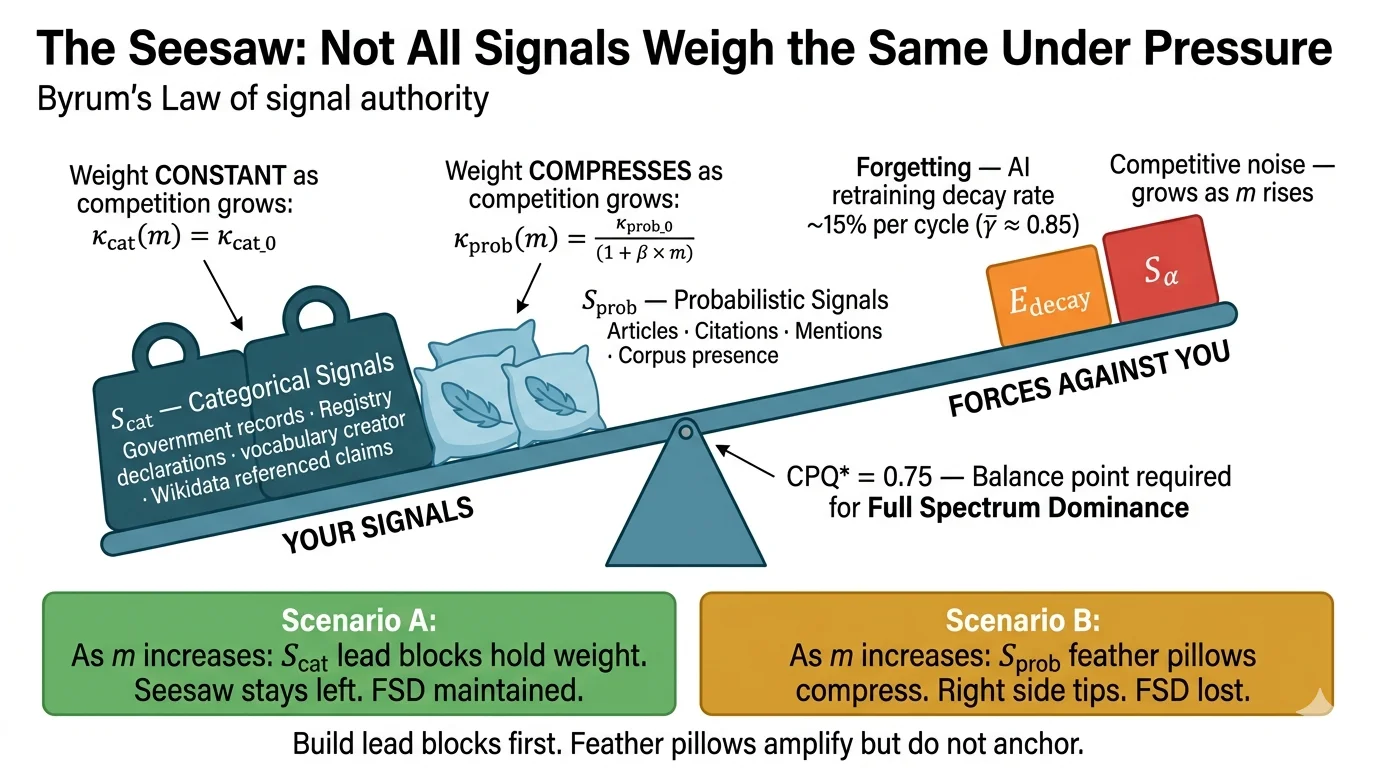
In today’s parametric LLM epoch, it’s all about a rate inequality: Sε,flow + Sε,stock > Eε(γ) + Sα. You’re trying to build faster than things decay and competitors take over. Eε(γ) > 0 — parametric memory erodes at about 0.010 CPQ per month between training cycles. If you don’t reinforce it, your CPQ drops. That means you have to keep building continuously.
To measure how well you’re building, you use the tools I’ve introduced: CPQ, EAS, Structured Data Entropy Rate, Parametric Recall Protocol, Web-Fetch-Disabled Recall Protocol. These are rate-epoch tools — they’re designed for a world where making information stick means actively maintaining it.
Byrum’s Law Phase Boundary: AI Architecture Transition
The Architectural Phase Boundary — AI Training Systems from Article 9 — isn’t a single moment. It’s a transition you can see. Here’s the measurable signal: CPQ stops responding to the flow signal pulses that used to work. If a Corroboration Campaign delivers much less CPQ improvement than you’d expect from history, then the architecture might be shifting toward explicit knowledge representation.
So here’s the detection protocol: watch the CPQ-to-construction-rate ratio across consecutive campaigns. If that ratio drops and stays below the 80% confidence interval of your historical data, that’s a phase boundary signal — time to escalate to architectural transition response mode.

Byrum’s Law Predicts a Completeness Problem in Future AI

In a world-model or explicit knowledge graph architecture, Eε(γ) goes to zero: facts stored in explicit knowledge graphs don’t decay between inference cycles like parametric weights do. So the rate inequality becomes a completeness threshold. Your entity needs to hit a knowledge graph completeness score (θ_KGR ≈ 0.85–0.95 — that’s the fraction of required entity attributes confirmed in the knowledge graph) to be citeable.
This change doesn’t destroy what you’ve built. It transforms it. The temporal depth you accumulated under parametric architectures becomes a knowledge-graph initialization advantage. Entities with deep temporal depth and high vocabulary sovereignty start the knowledge graph epoch with structural advantages that latecomers can never retroactively match. And remember Retroactive Irreproducibility from Article 2? That’s epoch-independent — it applies in both architectures, for different but equivalent structural reasons.
Why the Same Construction Program Works for Both Epochs
Here’s the thing: the construction program you follow for today’s parametric AI is basically the same one tomorrow’s knowledge graph AI will need. Why? Because knowledge graph completeness comes from the exact same signals as parametric weight construction. Structured data, authority database completeness, corroboration breadth, vocabulary sovereignty declarations — all of these feed into knowledge graph initialization quality during the transition.
So there’s no “wait and see” option. Every month you invest in construction today builds temporal depth, corroboration, and vocabulary attribution — and all of it transfers forward across the phase boundary. Every month you don’t invest, you lose temporal depth that you can never retroactively recover, in either epoch.
AutoGEO: A Tool for AI Content Optimization
I’ve built a practical tool for this: AutoGEO. It systematically extracts LLM preferences and rewrites content to align with the language patterns that current AI systems prefer when they cite authoritative sources.
| DEFINED TERM | AutoGEO |
|---|---|
| Definition | A system for LLM preference extraction and content rewriting: systematically querying AI systems to identify the specific language patterns, structural formats, and attribution signals that produce the highest CPQ for a given entity and category, then rewriting entity content to align with those patterns while maintaining factual accuracy and structured data coherence. AutoGEO operates at the content layer (L3 of the Dependency Chain) and requires the lower three layers to be complete before its outputs are effective. |
The EAV-E Standard: How to Structure AI-Citable Claims
The evidence framework that governs the quality of all entity claims, in both epochs, is the Entity-Attribute-Value-Evidence (EAV-E) standard. Every machine-readable, AI-citable claim must include: the entity, the attribute, the value, and the evidence — the source that backs it up.
| DEFINED TERM | Entity-Attribute-Value-Evidence (EAV-E) |
|---|---|
| Definition | A four-component evidence standard for machine-readable entity claims: Entity (which entity holds the attribute), Attribute (which property is being claimed), Value (the specific claimed value), and Evidence (the corroborating source that confirms the value). EAV-E extends the standard EAV data model by requiring explicit evidence for every claim — making each declaration both machine-readable and AI-citable. EAV-E compliance is required for full Tier-1 corroboration standing. |
| Formula | EAV-E: (Entity, Attribute, Value, Evidence) for every machine-readable claim |
Monthly, Quarterly, Annual Maintenance for AI Authority
Finally, here’s the ongoing maintenance program to sustain everything you’ve built. You need three measurement cadences as your minimum:
Monthly: Measure CPQ across at least three AI platforms (ChatGPT, Perplexity, Gemini) using the Controlled Testing Protocol — AI Citation for consistency. If you see a month-over-month decline of more than 0.05 CPQ, flag it for investigation.

Quarterly: Run a vocabulary attribution audit. Search each term you’ve coined online and check authority databases to make sure your first-creator attribution is intact. Look for any new competing lexicon declarations. And re-run the Parametric Recall Protocol to check that parametric memory is stable.
Annually: Re-baseline IDF. Recalculate IDFv scores as training data changes. Terms that were Tier 1 (very high IDF) might drop to Tier 2 as more people use them. Update your vocabulary sovereignty priority list accordingly.
On architecture transitions: Run the full EAS assessment under new AI system versions within 30 days of a major model release to confirm that temporal depth and vocabulary sovereignty have transferred forward.
josephbyrum.com | Byrum’s Law of Ontological Dominance: A First-Principles Series | Article 10 of 10

Joseph Byrum is an accomplished executive leader, innovator, and cross-domain strategist with a proven track record of success across multiple industries.