Table of Contents
How Non-Neutral Platforms Challenge Ontological Dominance

I’ve laid out Byrum’s Law across Theorems 1 through 7. But they all share an assumption that ignores platform non-neutrality. They assume the AI platform that retrieves information is a neutral arbiter. It picks the most trusted version of an entity based on its authority signals. It does this without any algorithmic favoritism for or against certain entities. That bias can come from business deals or ownership ties.
Theorem 8 tackles this non-neutrality head-on. Some AI platforms have commercial ties to specific advertisers or info providers. Some have ownership setups that create conflicts for certain entity types. Others train on data that leaves out some fields or highlights others. When any of these apply, the platform is not neutral. And CPQ measured on that platform does not purely show authority signal quality.
Theorem 8 — the Non-Neutrality Extension — explains what platform non-neutrality means, how to spot it, and what to do about it.
What Does Platform Non-Neutrality Look Like?
Platform non-neutrality shows up in the data as a gap between what authority signals predict and what CPQ actually shows. Here’s the key: that gap stays in the same direction across similar entities.
Suppose organizations in one industry show lower CPQ than their authority signals predict. This pattern shows up in many organizations in that category but not in others. Then the most likely reason is non-neutral retrieval affecting that category. If organizations with business deals with the platform consistently get higher CPQ than predicted, then commercial algorithmic distortion is likely.

Here is the formal definition from Theorem 8. The non-neutrality coefficient measures platform bias. It equals the gap between your actual CPQ on a platform and the CPQ your authority signals would get on a neutral platform. Positive bias means the platform boosts your representation beyond what your signals deserve. Negative bias means it lowers your representation below what your signals deserve.
Why AI Platform Bias Undermines Ontological Dominance Certification

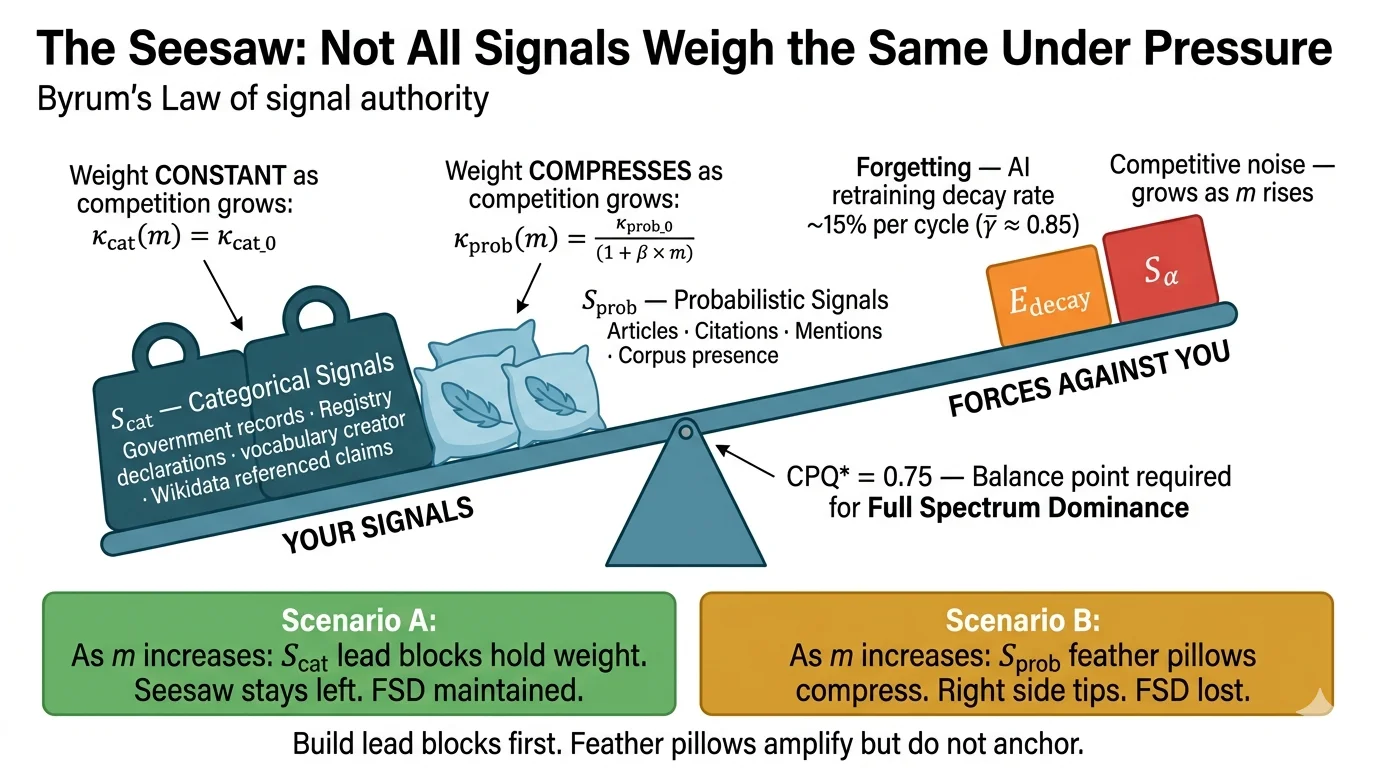
The most important practical effect of platform non-neutrality is this. FSD certifications from biased platforms do not really prove your authority signal quality. If an organization gets a CPQ above 0.75 on a platform that favors its category, it has not shown its authority signals are strong enough for FSD. The platform just likes its category.
Theorem 8 specifies the right standard. FSD certification must use CPQ measured on neutral platforms only. The set of platforms where you measure CPQ must skip platforms with known non-neutral retrieval in your category. Or you need to add a formal correction for the distortion.
This is not just nitpicking. If an organization gets FSD based on a platform that helps them, and then uses that to make business decisions, it may be acting on a false positive. For example, it might adjust investments, change strategy, or reduce signal maintenance. If the platform’s favoritism goes away, the organization’s CPQ could drop sharply. This can happen even if its authority signals stay the same.
Consider a hypothetical: a firm in a heavily advertised industry uses a search platform whose parent company owns major media in that industry. The platform ranks the firm highly, and the firm earns FSD. But when a neutral platform arrives, its CPQ falls below 0.75. The firm had been riding the platform’s commercial tailwind, not its own authority. This is the kind of false positive that Theorem 8 warns against.
Identifying and Mitigating AI Platform Bias in Your CPQ Measurements
How do you know if your platform is introducing AI platform bias? Look for patterns that repeat across similar entities. If your industry consistently over‑performs relative to authority signals, suspect positive bias. If your category under‑performs, suspect negative bias.
To mitigate, use the non‑neutrality coefficient as a diagnostic. Subtract the CPQ your authority signals predict on a neutral platform from your actual CPQ. A large positive value signals you may be an artificially boosted entity. A large negative value signals you may be suppressed. In either case, your FSD certification is unreliable until you use a neutral platform or apply a bias correction.

Also consider the platform’s ownership, funding, and training data. Check if the platform has exclusive deals with content providers in your field. Check if its algorithm was trained on datasets that overrepresent certain disciplines or regions. These are tell‑tale signs of potential AI platform bias.
The Long-Run Neutralization Equilibrium Corollary

Theorem 8 introduces a key idea with big long-term effects: Long-Run Neutralization Equilibrium. This says that under competition, platforms with non-neutral retrieval face reasons to become neutral over time.
Here’s why. Platforms that favor certain entities in search results lose trust and users. This is especially true for users who search in categories where the bias is strongest. As AI platforms become more central to business, users and organizations notice biased results. Platforms that keep distorting results face pressure from neutral options.
The long-run prediction: most commercial non-neutrality will fade as the AI platform market grows. That has a specific lesson for organizations now enjoying positive favoritism: treat that boost as temporary. Build your authority signals as if you’re operating on a neutral platform — because eventually you will be. Organizations that let genuine authority signal quality slide during a period of positive bias will get exposed when the favoritism goes away.
This equilibrium is not automatic. It depends on users having choice and on regulators paying attention. But the trend is clear: as the market matures, biased platforms lose share. The safest bet is to assume neutrality will prevail and invest in real authority signals.
Measure Ontological Dominance Across Multiple Platforms
The right response to platform non-neutrality is to measure across many platforms. Track CPQ across a portfolio of platforms — ones with different owners, business ties, and training data policies. When your CPQ readings differ a lot across platforms, it shows that non-neutral retrieval is at work. For example, you might have strong CPQ on some platforms and weak CPQ on others.
Here’s the practical standard. Measure CPQ across at least three platforms before making any certification or major investment. If the results line up, you can feel confident that algorithmic bias is not a big factor. If they differ a lot, dig into the source before trusting the highest reading.
Most organizations now measure their AI presence on the most convenient or most popular platform — often just one. That single-platform check works for rough tracking but not for certification-level choices. Measuring across three platforms costs little more than measuring on one, and it greatly lowers your risk.
For best practice, choose platforms from different categories: a general web search engine, a domain‑specific knowledge graph, an enterprise AI assistant, and an open‑source model aggregator. This diversification protects you from hidden non‑neutrality in any single provider.
Assessing Confidence in the Non-Neutrality Theorem
Theorem 8 got classified as VERDICT B after review. That means it’s a correct extension of Theorem 1’s scope that formally describes non-neutral retrieval. The non‑neutrality coefficient is formally derived from the Law’s conditions. The Long-Run Neutralization Equilibrium idea comes from the competition logic of Theorem 1. Checking specific patterns of platform bias in real tools — the planned field study — has not been done yet. The theory is sound. The next priority is mapping which real platforms show which forms of non‑neutrality.
Until that field study is complete, practitioners should treat Theorem 8 as a strong warning: assume every platform has some degree of bias until proven otherwise. Use the diagnostic tools described here — pattern checking, coefficient calculation, and multi‑platform measurement — to guard against false positives in your FSD certifications.
Next in this series: Theorem 9 — The World Model Framework. What happens to Byrum’s Law when AI shifts from encoding data to using world models? Your preparation for that change is already covered.

Joseph Byrum is an accomplished executive leader, innovator, and cross-domain strategist with a proven track record of success across multiple industries.